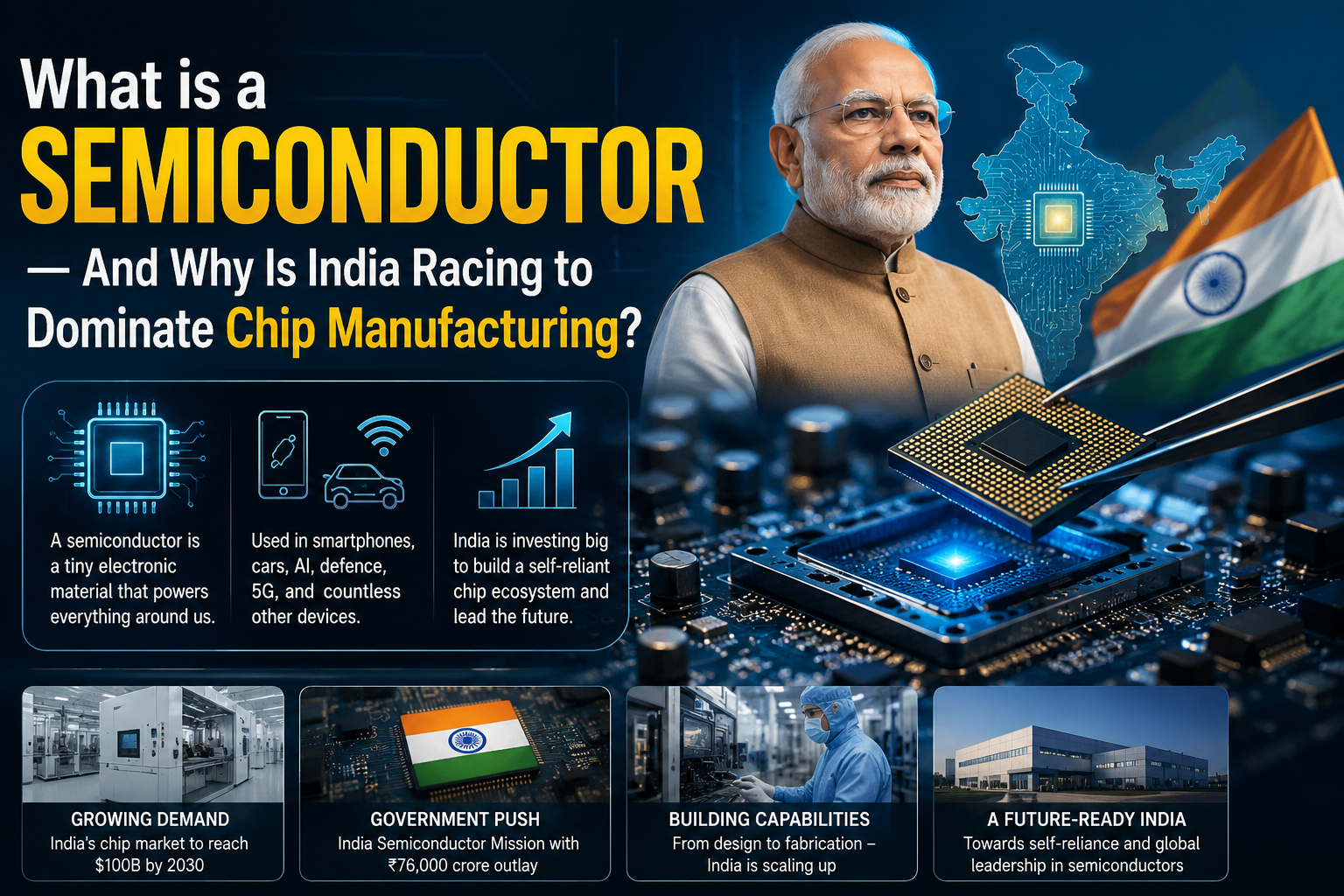
Whether it is your smartphone you are using, your laptop that you use, or even the cars running along the streets, they are powered by semiconductors. All these semiconductors are responsible for powering the whole world we live in today. However, before 2025, India did not have any of such semiconductors being manufactured. In 2025, India will have dedicated a massive ₹76,000 crore (~$10 billion) to develop their own chip industry through the India Semiconductor Mission.
But before comprehending India’s approach to semiconductors, let us address the most basic question being asked by millions of individuals: What is a semiconductor, and why is it so significant for the economic, military, and artificial intelligence future of nations?
What Is a Semiconductor? The Simple Explanation
A semiconductor is a substance that allows electricity to flow through it – but not entirely and only when certain conditions prevail. Semiconductors lie between conductors (which allow the free flow of electric current) and insulators (that block electric current). The controlled conductive property of semiconductors gives rise to their application in electronic devices.
The commonly used semiconductor material is silicon, extracted from sand. Other examples include germanium, gallium arsenide, and silicon carbide. By adding small amounts of elements like phosphorus and boron to silicon, the electrical properties of silicon can be altered to manipulate electric currents.
“A semiconductor is not just a material — it is the language modern machines use to think, communicate, and compute.”
Semiconductor Meaning in Everyday Terms
Consider the case of a semiconductor, which behaves much like an intelligent traffic light. A normal conductor is akin to an open road where cars (electrical current) can pass without restriction. An insulator is a solid wall where cars cannot pass at all. A semiconductor serves as the intelligent traffic light that allows cars to pass or not, and this happens billions of times each second within computer chips.
Types of Semiconductors
Understanding the types of semiconductors helps explain why they are used across such a wide range of applications:
| TYPE | DESCRIPTION | EXAMPLES |
|---|---|---|
| Intrinsic | Pure semiconductor material, no impurities | Pure silicon, pure germanium |
| Extrinsic (N-type) | Doped with electron donors (e.g., phosphorus) | Used in transistors, diodes |
| Extrinsic (P-type) | Doped with electron acceptors (e.g., boron) | Used in solar cells, LEDs |
| Compound | Two or more elements combined | GaAs (telecom), SiC (EVs, power electronics) |
Uses of Semiconductors: They Are Everywhere
Uses of semiconductors are present in almost all industries on earth. The modern semiconductor chip, also known as the microchip or computer chip or integrated circuit, is designed to fit billions of transistors into an area smaller than that of a fingernail.
- Consumer Electronics: Smartphones, laptops, tablets, smart TVs, wearables
- Automotive: Electric vehicles, ADAS (driver-assist systems), in-car infotainment
- Defence & Aerospace: Guided missiles, radar systems, satellites, communication equipment
- Telecommunications: 5G base stations, fibre-optic routers, satellite modems
- Healthcare: MRI machines, pacemakers, glucose monitors, AI diagnostics
- Artificial Intelligence: AI semiconductor chips (GPUs, NPUs) powering ChatGPT, autonomous vehicles, data centres
- Renewable Energy: Solar inverters, wind-power controllers, smart grid systems
How Semiconductor Chips Are Made: A Brief Overview
Chip making is one of the manufacturing processes ever. Here is how semiconductor chips are made, step by step:
1. Wafer Production: We melt high-purity silicon. Grow it into big cylindrical ingots. Then we slice them into thin discs called silicon wafers. We polish these wafers until they are almost atomically smooth.
2. Photolithography: We print circuit patterns on the wafer using light. Similar to how you develop photos but way smaller. A single chip can have over 50 billion transistors that’re smaller than a virus.
3. Doping & Etching: We use chemicals to add impurities to areas to create N-type and P-type regions. Then we etch away the material to create the circuit architecture.
4. Deposition & Layering: We. Pattern dozens of material layers. Like metals, insulators and semiconductors. To build the full three-dimensional chip structure. Modern chips have over 100 layers.
5. Testing & Packaging: We test each wafer electrically. Good chips are cut out put in packages and wired to external connectors before being shipped all around the world.
These chip fabrication plants or fabs are dust-free cleanrooms that cost, between $10 billion and $20 billion each to build.
India Semiconductor Mission Explained: What Is India’s Plan?
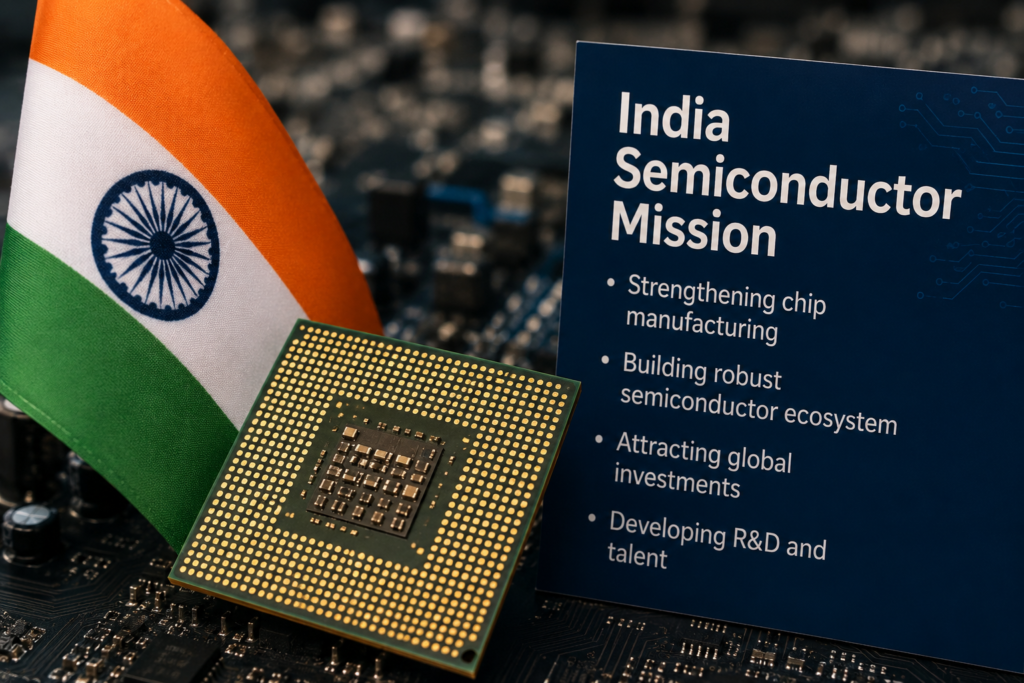
In the year 2021 the Government of India started the India Semiconductor Mission under the Ministry of Electronics and Information Technology. This is a big plan for India and it has been a long time since the country has done something like this. The goal of the India Semiconductor Mission is to create a place in India where semiconductors can be made from start to finish.
The India Semiconductor Mission gives money to companies that want to set up places to make chips, displays or package semiconductors in India. The Government of India will pay up to half of the cost for these projects. The total amount of money the Government of India is willing to spend is ₹76,000 crore, which’s around $10 billion. This shows that the people in charge in New Delhi think the semiconductor sector is very important, for India.
Why Is India Focusing on Semiconductor Manufacturing?
The recent corona virus outbreak highlighted one major issue that proved dangerous – the global semiconductor chip shortage that forced car factories to close their operations, delayed shipment of electronic products, and resulted in economic losses of around $500 billion globally. Nations that did not have the capability to produce their own chips were vulnerable to foreign suppliers, and India was one of them.
India is completely reliant on importing all of its semiconductors and spends more than $24 billion per year on the importation of semiconductor chips. If India plans on becoming a trillion-dollar electronics manufacturing nation by 2030, there is no other way but to develop its chip industry, and fast.
“Chips are the new oil. Nations that can make them will define the 21st century economy.”
Top Semiconductor Companies Investing in India
The India semiconductor industry has attracted significant global attention. Several major semiconductor companies and chip manufacturing companies have already committed or are in advanced negotiations:
| COMPANY | COUNTRY | PROJECT IN INDIA | INVESTMENT |
|---|---|---|---|
| Tata Electronics + PSMC | India / Taiwan | Fab in Dholera, Gujarat (28nm node) | ~$11 billion |
| CG Power + Renesas + Stars Microelectronics | India / Japan / Thailand | ATMP facility in Sanand, Gujarat | ~$740 million |
| Kaynes Semicon | India | ATMP plant in Sanand, Gujarat | ~$340 million |
| Micron Technology | USA | Semiconductor assembly & test, Sanand | ~$825 million |
| Applied Materials | USA | Engineering R&D centre, Bengaluru | Undisclosed |
Several semiconductor startups in India are also emerging in chip design — firms like Signalchip, Saankhya Labs, and InCore Semiconductors are developing indigenous integrated circuits for 5G, satellite communications, and RISC-V based processors.
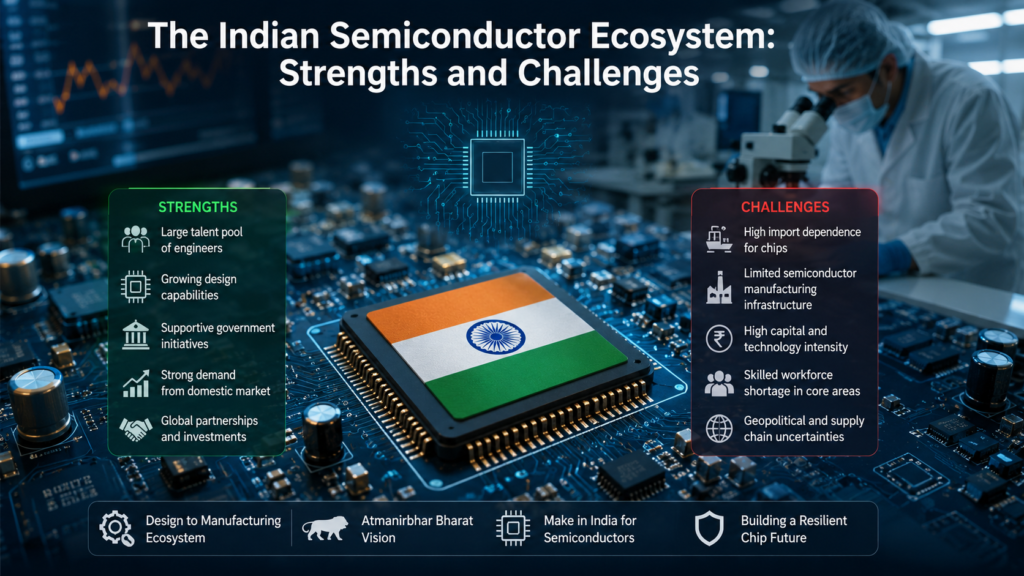
The Indian Semiconductor Ecosystem: Strengths and Challenges
India’s Competitive Advantages
India adds value to the global semiconductor sector. At present, India accounts for more than 20% of the global semiconductor design talent pool. Several leading semiconductor design firms such as Intel, Qualcomm, Texas Instruments, and AMD maintain their chip design hubs in cities like Bengaluru, Hyderabad, and Pune, hiring thousands of semiconductor engineers.
In addition to being a significant destination for outsourced semiconductor chip design, the Indian semiconductor sector is booming. The Indian semiconductor sector will likely grow to $100 billion by 2030 from an estimated $30 billion currently.
Key Challenges Ahead
Even with the existing drive towards chip production, there are challenges facing the chips manufacturing in India. The process requires pure water and energy on a consistent basis, in addition to chemicals that are very rare. There is a lack of technicians in the field of semiconductor production in India. Equipment from ASML, Applied Materials, and Lam Research also pose another challenge.
Strategic Impact: Why Chip Manufacturing Is Important for India
The significance of semiconductors to India is not just economic but extends to being a question of security for the country. Semiconductors play a crucial role in India’s defence mechanisms ranging from the jet fighters used by the Indian Air Force to its communications satellites to intercontinental ballistic missiles.
Economically speaking, the establishment of semiconductor chip fabrication plants in India offers an enormous multiplier effect since for every one chip fabrication job, there would be five to ten ancillary jobs created in chemical production, logistics, machine maintenance, etc. As such, with the advent of the semiconductor industry in India, it is expected that around 300,000 jobs would be created in the decade ahead.
In addition, it can be said that India’s efforts in establishing a semiconductor industry is part of a broader trend of geopolitical realignments. In that respect, it should be mentioned that even the United States, European Union, Japan and South Korea have begun offering subsidies to encourage semiconductor chip fabrication within their territories in order to be less reliant on Taiwan and China.
Key Highlights at a Glance
- India spends ~$24 billion/year importing semiconductor chips
- The India Semiconductor Mission has an outlay of ₹76,000 crore (~$10B)
- India’s semiconductor market is projected to hit $100 billion by 2030
- Tata–PSMC fab in Dholera is India’s first commercial wafer fabrication plant
- India has 20%+ of the world’s chip design workforce but makes almost no chips yet
- The global semiconductor industry exceeded $600 billion in revenue in 2024
- AI semiconductor chips (GPUs, AI accelerators) are the fastest-growing segment globally
- India’s semiconductor policy offers up to 50% capital subsidy for eligible projects
Can India Become a Semiconductor Hub? The Future Outlook
The question is always on everyone’s mind who works in policymaking, investments, or engineering sectors – Can India be a semiconductor hub? It seems like the answer is slowly evolving from a ‘maybe’ to a ‘yes’. Over time.
The first round of fabs in India that focus on legacy nodes (28 nm-65 nm) and semiconductor packaging will be operational in 2026-2028. These are not state-of-the-art chips, but they are used extensively for meeting the demands of the world. They include microcontrollers for domestic appliances, automotive semiconductors, power management chips for solar panels, and much more.
Within a decade, if India can build its talent pool, secure the supply chain for specialty chemicals and gases, and create regulatory certainty, India may get chances of manufacturing chips in advanced nodes or AI semiconductor packaging. There seems to be an exciting future for India’s semiconductor sector, but it will take many decades and billions of dollars of investments.
India is already seeing a rise in the number of semiconductor jobs in the country, and institutes such as IIT Bombay, IIT Madras, and BITS Pilani are expanding their semiconductor engineering courses.
Frequently Asked Questions (FAQs)
Q. What is a semiconductor and how does it work?
A semiconductor is a material — typically silicon — that conducts electricity partially and in a controllable manner. By doping it with specific impurities and structuring it into transistors, engineers create integrated circuits (chips) that can process, store, and transmit data. Billions of such transistors switch on and off billions of times per second inside your devices, enabling everything from phone calls to artificial intelligence.
Q. Why are semiconductors so important?
Semiconductors are the fundamental building blocks of all modern electronics. Without them, there would be no smartphones, computers, internet infrastructure, electric vehicles, medical devices, or defence systems. As AI, 5G, and the Internet of Things expand, semiconductor demand will only accelerate — making them arguably the most strategically critical material in the world today.
Q. What is India’s Semiconductor Mission?
The India Semiconductor Mission (ISM), launched in 2021 under the Ministry of Electronics and Information Technology, is a ₹76,000 crore (~$10 billion) national programme to build a domestic chip manufacturing ecosystem. It provides capital subsidies of up to 50% to companies setting up fabrication plants, ATMP (assembly, testing, marking, and packaging) facilities, and semiconductor design infrastructure within India.
Q. Which companies are investing in India’s semiconductor industry?
Major investors include Tata Electronics (partnered with Taiwan’s PSMC for a fab in Dholera), Micron Technology (ATMP facility in Sanand), CG Power in partnership with Japan’s Renesas, and Kaynes Semicon. Global design and equipment companies like Applied Materials, Intel, Qualcomm, and Texas Instruments also have significant engineering centres in India.
Q. Can India become a global semiconductor hub?
India has the talent, the market, the policy support, and growing investment momentum to become a significant player in global chip manufacturing — particularly in legacy node fabrication and semiconductor packaging. However, competing at the cutting edge (3nm, 2nm chips) requires technology access, massive capital, and decades of manufacturing experience that India is only beginning to accumulate. The medium-term outlook is promising; the long-term potential is substantial.