The Shocking Revelation: Face Burns & Plastic Surgery
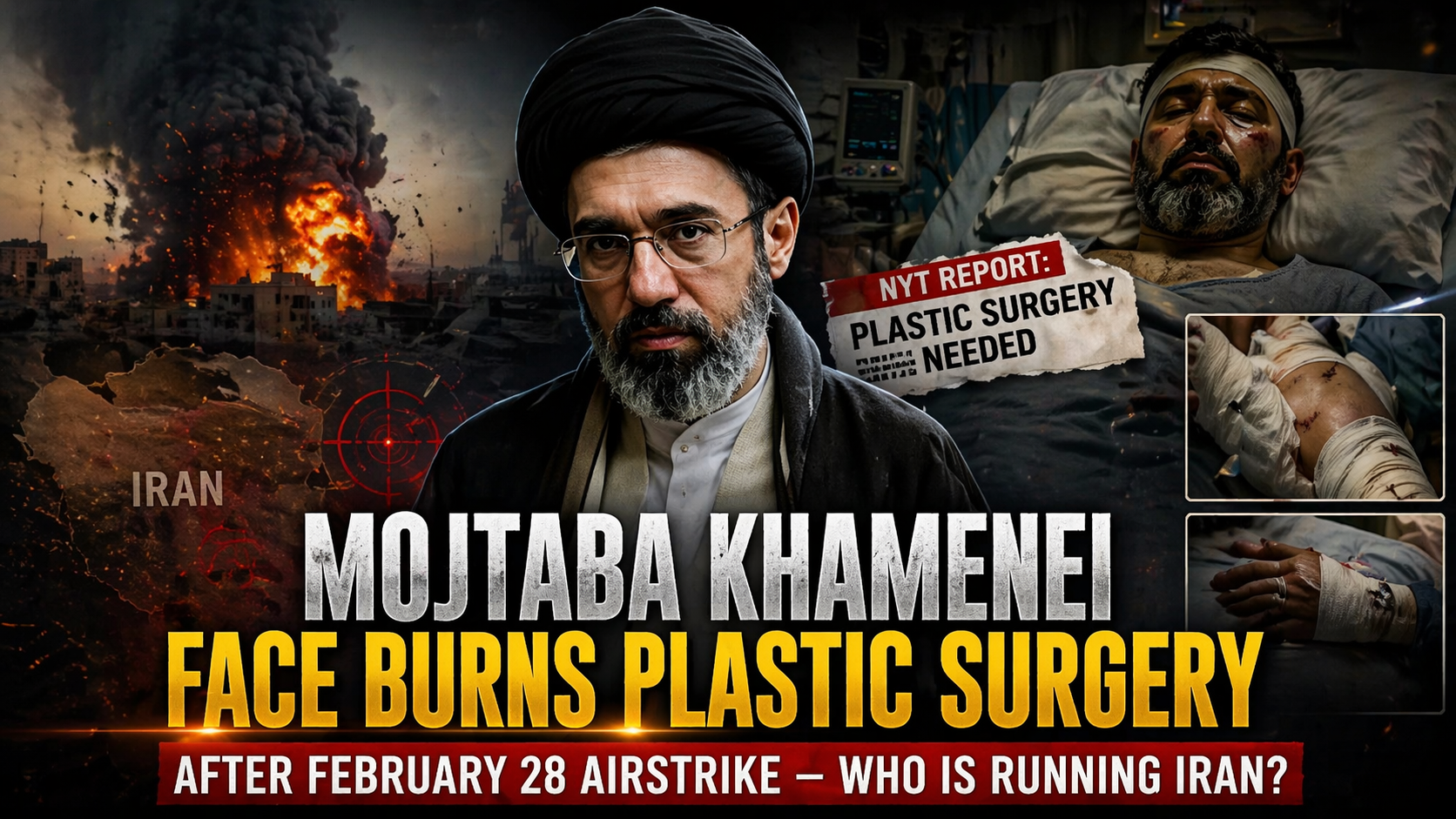
In a bombshell investigative report published Thursday, the New York Times revealed that Iran’s Supreme Leader Mojtaba Khamenei sustained severe burn injuries to his face and lips during the February 28 US-Israeli airstrike that devastated Iran’s leadership compound. According to four senior Iranian officials familiar with his condition, the facial burns have made it extremely difficult for the 56-year-old leader to speak, and doctors have confirmed that he will eventually require reconstructive plastic surgery to address the disfigurement.
Key Finding: Mojtaba Khamenei’s face and lips are severely burned, affecting his ability to speak. Medical officials say plastic surgery is not optional — it is medically necessary for recovery.
This report confirms what US Defense Secretary Pete Hegseth had indicated in March — that the new Iranian Supreme Leader was “wounded” and likely disfigured. The Khamenei health update has sent shockwaves through global political circles, raising pressing concerns about the Iran leadership crisis and who is actually steering Tehran’s decisions during the ongoing conflict.
The February 28 Strike: What Happened
The turning point came on February 28, 2026, when the United States launched Operation Epic Fury — a coordinated strike on key locations tied to Iran’s top leadership. The US-Israeli airstrike on his father’s compound resulted in the death of former Supreme Leader Ayatollah Ali Khamenei, along with Mojtaba’s wife and son. The attack nearly killed Mojtaba as well.
Nearly 50 members of Iran’s top leadership were killed in the initial wave of strikes. Mojtaba Khamenei — who was residing within or near the targeted compound — survived but sustained catastrophic injuries that required immediate, intensive medical intervention. He was subsequently selected by a council of senior clerics as Iran’s new Supreme Leader.
Full Extent of Khamenei’s Injuries: Beyond the Face Burns
The Mojtaba Khamenei injuries are far more extensive than initially reported by Iranian state media. The NYT’s sourced account paints a deeply alarming picture of a leader in a medically fragile state:
Leg: One leg underwent three separate surgical procedures. Doctors have not ruled out the need for a prosthetic limb. Khamenei is currently awaiting a prosthetic.
Hand: Surgery on one hand has been completed. Recovery is described as slow, and the hand has not yet regained full function.
Face & Lips: Severe burn injuries to the face and lips have impaired speech. Reconstructive plastic surgery is expected.
Mental State: Despite the grave physical condition, officials confirmed he is mentally sharp and engaged — capable of understanding information and making decisions.
No Public Appearances: Why Khamenei Is Hiding
Since the February 28 attack, Mojtaba Khamenei has not appeared in any public video or audio message. The NYT report reveals that the Iranian Supreme Leader’s absence from public view is deliberate — he reportedly does not wish to appear vulnerable or sound weak in his first public address.
All official communications are being issued in written form, read on state television. Access to Khamenei is described as extraordinarily restricted, with only doctors and a handful of healthcare professionals physically allowed near him — partly to keep his undisclosed location secret from adversaries.
Courier Chain: Messages to Iran’s Supreme Leader are handwritten, sealed in envelopes, and relayed through a human courier chain — traveling via cars and motorcycles on highways and back roads before reaching Khamenei’s secure location.
Iran Leadership Vacuum: Who Is Running Iran?
The most critical geopolitical question emerging from this crisis is: who is actually governing Iran? Experts and insiders paint a divided picture of a fractured power structure held together by the Islamic Revolutionary Guards Corps (IRGC).
Sanam Vakil, Director of the Middle East and North Africa programme at the Chatham House think tank, told the NYT that “Mojtaba is not yet in full command or control.” She added that while he signs off on decisions, he is being presented with fait accompli — meaning decisions are largely already made before reaching him.
Ali Vaez, Iran Director at the International Crisis Group, was more blunt: “Mojtaba is not supreme; he might be leader in name, but he is not supreme the way his father was.” Real operational power, sources suggest, rests with IRGC generals, with Khamenei described as a “director of the board” while the generals function as board members.
Impact on Iran-US Peace Talks
The Iran-US war negotiations have been further complicated by Khamenei’s health crisis. The Trump administration has cited slow communication and uncertainty about whether Foreign Minister Abbas Araghchi and Parliament Speaker Mohammad Bagher Ghalibaf have the authority to represent Iran’s final position. The Iran peace talks remain stalled, partly due to this Iran leadership vacuum.
Reuters separately reported that Khamenei participates in some meetings via audio calls, maintaining an advisory role in decisions related to the war and potential diplomatic talks with Washington — though his capacity for full command is clearly limited by his injuries.
Iran’s Official Response: Denial vs. Reality
It is important to note that the Iranian government has always claimed that there is no real cause for concern about Khamenei’s state. But the NYT reports based on sources close to the situation, including four high-ranking Iranian officials, which clearly refutes the claim made by the Iranian government. There is a huge difference between the statement made by the Iranian government and the intelligence information available.
What Happens Next: Political & Medical Outlook
As the recovery process of Mojtaba Khamenei proceeds, the future course of action of the government of Iran is highly uncertain. On one hand, the strengthening of the power of the IRGC may help to solidify the position of the Iranian regime, but it may lead to internal conflict as well. Moreover, the chance to have Iran-US talks about cease-fire largely depends upon the capacity of the Iranian regime to negotiate, which would be rather challenging with an injured supreme leader.
When the time comes and Khamenei undergoes plastic surgery, it will signal the beginning of a new phase for the leader – the first time he can appear publicly since the air raid carried out back in February. Until then, Iran’s new Supreme Leader is nothing more than a phantom, ruling through closed letters and phone calls only.