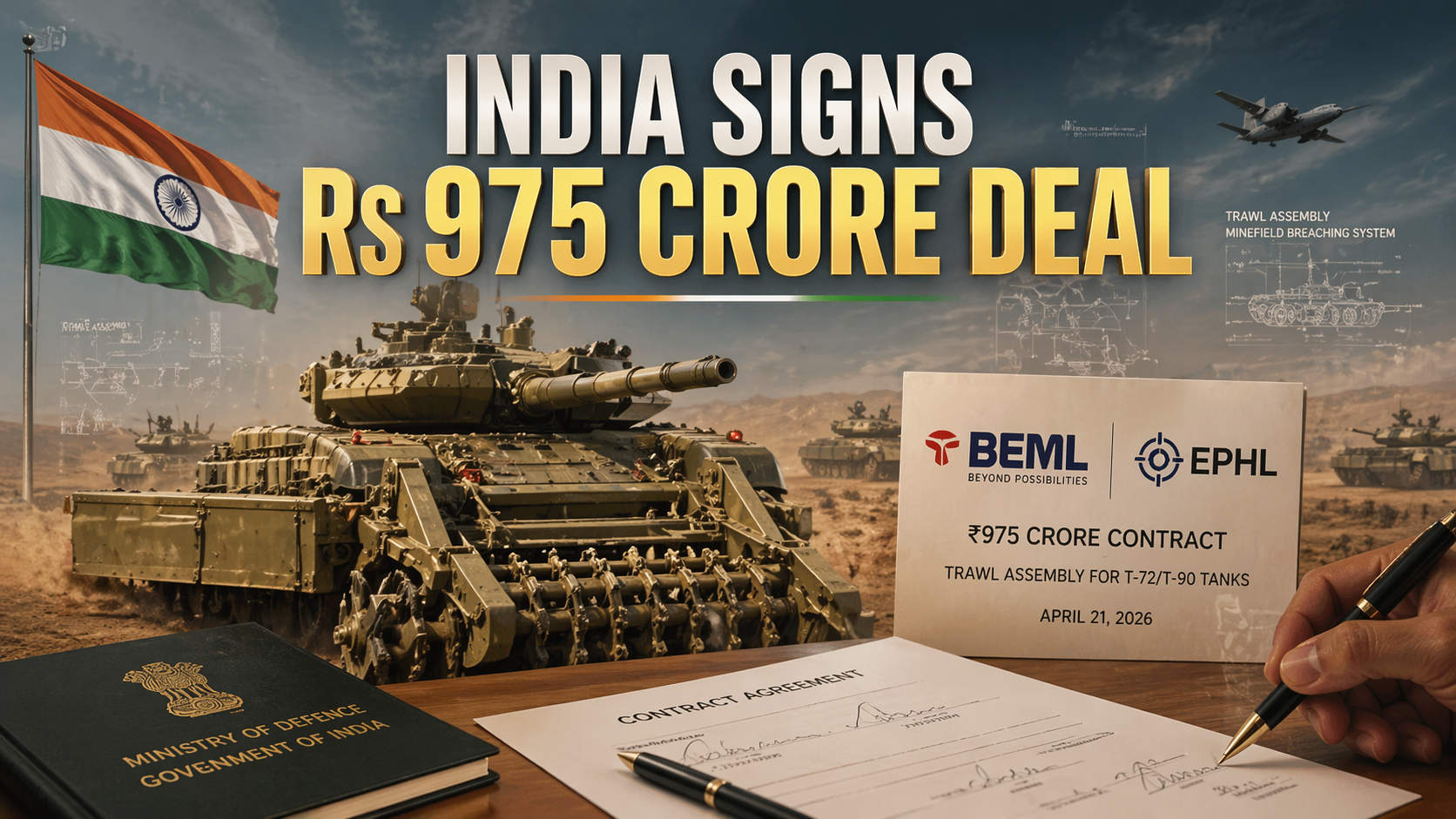
India Rs 975 Crore Minefield Breaching Deal DRDO TRAWL 2026- In what can be considered one of the most important defence deals by India in 2026, Ministry of Defence (MoD) has on 21st April, 2026, formally signed contracts for approximately Rs 975 crore to procure TRAWL Assembly systems compatible with the T-72 (Ajeya) and T-90 (Bhishma) tanks of the army’s armoury, a step that will go a long way in increasing the ability of the Indian Army to breach through minefields.
This milestone was achieved when the historic signing took place in New Delhi, witnessed by the Defence Secretary Mr. Rajesh Kumar Singh, in the context of the Indian government’s consistent efforts towards enhancing military capability as part of the Aatmanirbhar Bharat mission. This deal was won by two major names from the Indian defence industry – namely Bharat Earth Movers Limited (BEML) and Electro Pneumatics and Hydraulics (India) Private Limited (EPHL) — both of which are recognised champions of indigenous defence manufacturing.
⚡ KEY FACTS AT A GLANCE
What Is the DRDO TRAWL Assembly? Technology Explained
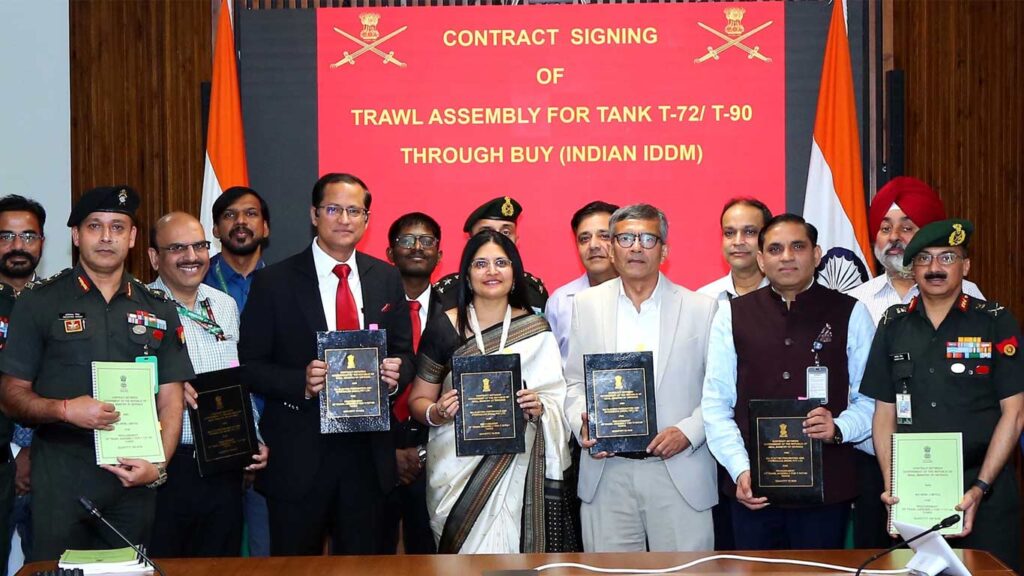
At the heart of this defence deal is the indigenously engineered TRAWL Assembly — a critical combat engineering system developed by the Defence Research and Development Organisation (DRDO). The TRAWL system is a specialised mine-clearing equipment that is physically mounted onto the front hull of a battle tank and deployed ahead of advancing armoured columns in battlefield environments.
The system works by detecting, detonating, or displacing anti-tank mines fitted with proximity magnetic fuses — one of the deadliest threats in modern land warfare. Unlike conventional explosive ordnance disposal methods, the TRAWL assembly allows a tank crew to operate safely inside the vehicle while the apparatus clears a path ahead, enabling the creation of designated Vehicle Safe Lanes through minefields for trailing armoured units, infantry, and logistics convoys to pass through without risk.
Crucially, the TRAWL system is engineered to withstand direct blast pressure from mine detonations beneath the tank without compromising either the vehicle’s structural integrity or the safety of the crew — a feature that makes it invaluable in high-intensity armoured warfare scenarios along India’s contested land borders.
T-72 Ajeya & T-90 Bhishma: India’s Armoured Backbone

The T-72 Ajeya is an old Soviet-made main battle tank that has been used as a trusted and efficient force multiplier of the Indian Army’s Armoured Corps since many years past. Nevertheless, this tank remains to see active duty due to its numerous modifications made over the years, including those that increase its capability to attack, defend, and provide effective night vision.
In comparison, the T-90 Bhishma is considered as the ultimate evolution of India’s tank upgrade project, boasting new composite armor and explosive reactive armor, thermal sight system, and upgraded fire controls. Together, both the T-72 and the T-90 form the main thrust of Indian armored forces operating in multiple strategic areas against both Chinese and Pakistani military contingents.
Hence, integrating the T-72 and T-90 tanks with the TRAWL Assembly from DRDO will fill a vital need for India’s offensive armored warfare doctrine, which revolves around the need for rapid penetration of highly mined enemy lines and creation of safe passages through which other units can pass safely.
BEML and EPHL: Champions of Make in India Defence
Bharat Earth Movers Limited (BEML), a public sector undertaking under the Ministry of Defence, is a multi-product, multi-technology conglomerate with deep expertise in defence, mining, and infrastructure equipment. Its inclusion in this ₹975 crore deal underlines its pivotal role in India’s defence industrial ecosystem.
Electro Pneumatics and Hydraulics (India) Pvt Ltd (EPHL) has secured a sub-contract of Rs 385 crore for the supply of 70 sets of TRAWL assemblies under the programme. The company confirmed this in an official social media post, describing it as a landmark achievement for its indigenous defence manufacturing capabilities.
Both firms are required to source components and sub-assemblies predominantly from domestic suppliers, MSMEs, and local vendors — a requirement embedded within the Buy (Indian – Indigenously Designed, Developed and Manufactured) — or Buy (Indian-IDDM) — procurement category under which this deal has been structured. This category represents the highest level of indigenous content mandated by India’s defence acquisition policy.
📌 DEAL STRUCTURE – QUICK BREAKDOWN
Strategic Significance: Why This Deal Matters for India’s Security
The acquisition of the Rs 975 crore worth TRAWL assembly has major strategic significance for the overall defence strategy of India. Its borders, including the Line of Actual Control (LAC) with China and the Line of Control (LoC) with Pakistan, feature a difficult terrain where mine warfare poses a serious challenge.
During high-intensity warfare situations, the need to create breaches in the enemy defences and move through difficult terrains without facing any losses and delays is an essential requirement for achieving victory on the battlefield. The DRDO TRAWL Assembly provides this capability to the Indian forces, helping them to breach enemy lines rapidly without having to take huge losses.
It has been observed that many Asian countries are faced with the challenge of not having mine warfare countermeasure capability. The bold decision taken by the Indian government to manufacture the TRAWL system domestically indicates a maturing defence industry in the country, with faith in the capabilities of the DRDO for producing combat systems.
Aatmanirbhar Bharat & Make in India: The Bigger Picture
This is much more than a mere military purchase contract. This is a bold statement of intent under Prime Minister Narendra Modi’s flagship initiative, Aatmanirbhar Bharat – a daring national mission to make India a self-reliant superpower in terms of defence manufacturing so as to fulfill its own security needs and position itself as a leading military exporter.
The Make in India initiative by the government has steadily raised the threshold on indigenization norms with respect to defense purchases, making it mandatory for the defence ministry to choose contracts under the Buy Indian IDDM classification over any other. This deal perfectly illustrates this policy – the equipment, rather than being just assembled in India, will be developed and tested in India as well, by DRDO, and will be produced in India through indigenous production chains.
Such a deal has huge economic multipliers as well. Defence deals of such a magnitude involve the participation of hundreds of MSMEs, tier-2 suppliers, ancillary industries etc., thus contributing not only to the growth of defence sector, but to the entire economy.
India’s Recent Defence Procurement Momentum in 2026
The ₹975 crore TRAWL deal comes on the back of a sustained wave of Indian defence procurement activity in 2026. Earlier this year, the Ministry of Defence concluded a ₹1,950 crore contract with Bharat Electronics Limited (BEL) for two Mountain Radar systems for the Indian Air Force, and a separate ₹2,312 crore deal with Hindustan Aeronautics Limited (HAL) for eight Dornier 228 aircraft for the Indian Coast Guard — all under Buy Indian categories.
Operational Impact: A New Edge for India’s Armoured Corps
For the Indian Army’s Armoured Corps, the induction of the TRAWL Assembly across its T-72 Ajeya and T-90 Bhishma fleets will fundamentally change the dynamics of armoured assault operations. Currently, breaching a well-laid anti-tank minefield typically requires either slow, methodical manual clearance using combat engineers — which exposes personnel to significant risk — or the use of specialised mine-clearing vehicles that may not always be available in adequate numbers.
The TRAWL system changes this calculus entirely. By integrating the mine-clearing capability directly onto frontline battle tanks, the Indian Army gains the ability to conduct rapid, self-contained breaching operations using forces that are already committed to the assault — without the need to halt the advance and wait for specialised engineering support. The creation of Vehicle Safe Lanes through minefields on the move will enable faster penetration, reduced casualty risk, and greater tactical surprise — all critical factors in modern high-tempo warfare.
DRDO’s Role: India’s Indigenous Defence Innovation Engine
The DRDO TRAWL Assembly is yet another example of how India’s Defence Research and Development Organisation has evolved from a research body dependent on foreign technology transfers into a genuinely capable indigenous weapons developer. The DRDO has in recent years delivered an impressive portfolio of battlefield-ready systems including Arjun Main Battle Tank components, Pinaka multi-barrel rocket systems, Akash surface-to-air missiles, and now the TRAWL mine-clearing assembly — all under Make in India frameworks.
Having completed rigorous field trials validating the TRAWL’s efficacy across varied mine types and terrain conditions, the system is now battle-ready and cleared for full-scale induction — a development that will significantly upgrade the lethality and survivability of India’s premier armoured strike formations.
Conclusion: A Defining Moment for India’s Defence Self-Reliance
Rs 975 crore deal for Minefield breaching capability inked on April 21, 2026, not only marks a successful procurement process but also stands as a striking representation of India’s rapid move towards full-scale defence self-reliance. With indigenous innovations by DRDO, manufacturing in established Indian firms such as BEML and EPHL, and requirement to meet the criteria of Buy (Indian-IDDM), the Ministry of Defence has managed to enhance combat capabilities, lessen reliance on imports, and stimulate the Make in India sector all at once.
On the one hand, the Indian Army is set to benefit from increased operational effectiveness owing to TRAWL Assembly for T-72 & T-90 tanks; on the other hand, India’s defence manufacturing sector will gain confidence in the fact that India’s engineers and scientists possess the ability to deliver world-class military equipment without relying on any external force – thus making the country more independent in matters related to its security.