
What Is an SSBN and Why Does India Need One?
India’s Nuclear Submarines: Arihant, Arighat & Chakra Explained- The SSBN (Submarine-Launched Nuclear-Powered Ballistic Missile) is considered to be the most survivable weapon of the nuclear arsenal. As compared to land-based missiles, which are stationary and thus vulnerable, as well as planes that can be shot down in mid-air, an SSBN submarine cruising quietly in the deep sea is near impossible to detect and target.
India’s nuclear doctrine is based on the principle of “No First Use” (NFU), meaning that India commits itself to refraining from being the first one to launch a nuclear attack. For the No First Use principle to be effective, India must have the capacity for absorbing the initial strike and retaliating effectively. The capacity for this kind of second strike is precisely what SSBNs provide.
Pakistan and China, two countries whose nuclear armament is no secret, share a border with India. Pakistan follows a first-use nuclear doctrine, whereas China is fast developing its own fleet of submarines. Under these circumstances, sea-based nuclear deterrence becomes absolutely essential for India.
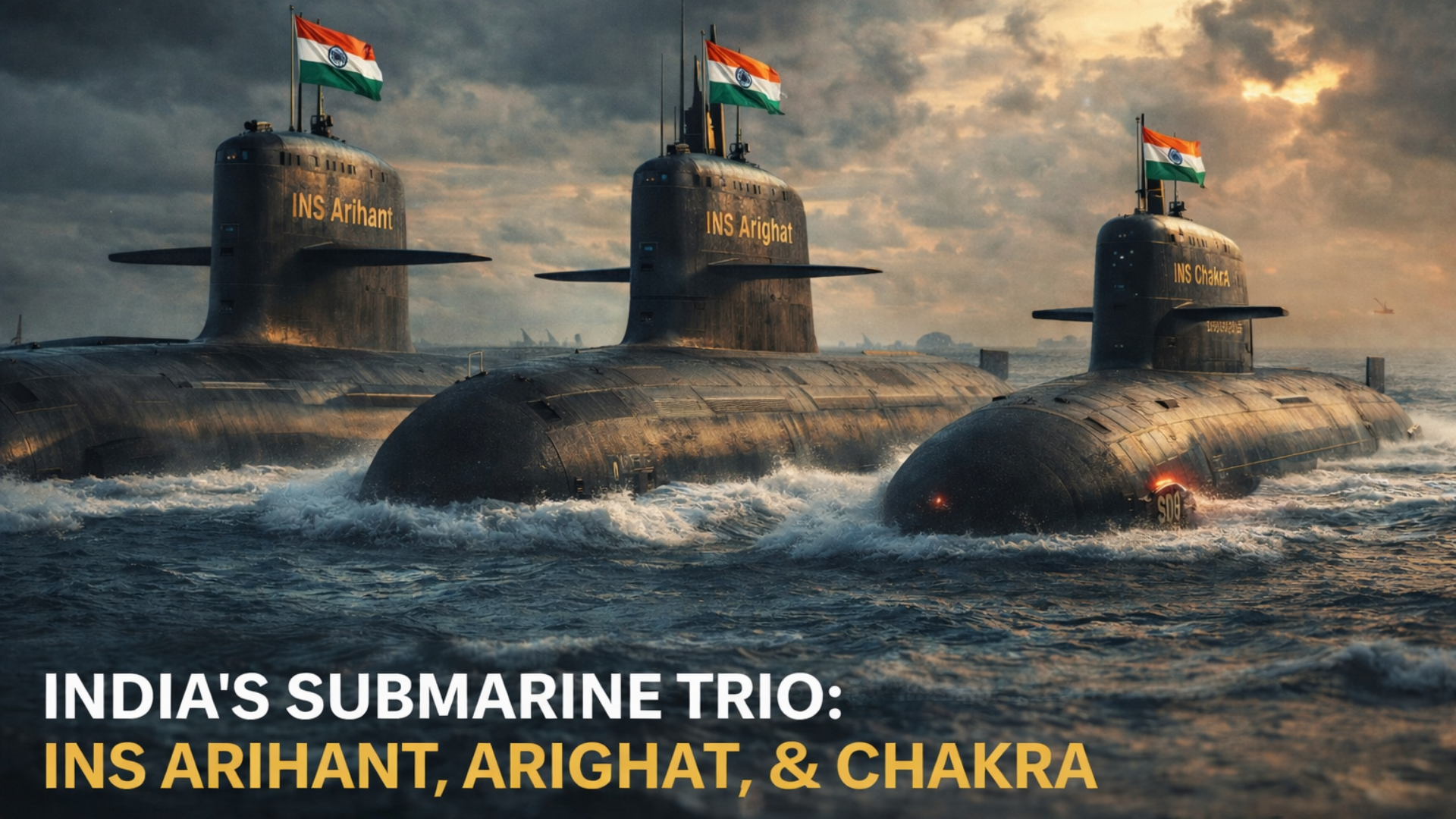
At the bottom of the Bay of Bengal lies India’s most deadly arsenal patrolling in secret — invisible to both radar and satellite, almost impossible to detect. The INS Arihant, the INS Arighat, and the INS Chakra are not ordinary submarines; they are India’s best defense in an area that possesses nuclear capabilities. These vessels complete India’s nuclear triad, which enables its armed forces to deliver nuclear strikes from ground, air, and water, guaranteeing that a first strike from any enemy will always receive a response. By 2026, the submarine-launched nuclear deterrent capability of India would grow at an unprecedented pace.
INS Arihant: India’s Historic First
The Beginning of India’s Nuclear Sea Power
Arihant means “Enemy Destroyer” in Sanskrit, which aptly reflects the function of this submersible in ensuring credibility of India’s nuclear deterrence. INS Arihant (SSBN 80) was built under the Advanced Technology Vessel (ATV) project in the Ship Building Centre, Visakhapatnam. Launched on 26 July 2009, i.e., the tenth anniversary of India’s victory in the Kargil War, the Arihant was commissioned into service by Prime Minister Narendra Modi in August 2016.
Why is INS Arihant of historical significance? First, it makes India the first country outside the five permanent UN Security Council members (USA, Russia, China, the UK, and France) to have developed, manufactured, and operated an indigenous nuclear-powered ballistic missile submarine. Arihant runs on a compact light water reactor of 83 MW built by the Bhabha Atomic Research Centre with the help of Russia in designing a miniaturized reactor for use aboard the submarine.
INS Arihant conducted India’s first deterrence patrol on 4 November 2018, a 20-day mission that saw India enter a club of only a few countries able to conduct sustained nuclear patrols in seas. As of October 2024, Arihant continues conducting deterrence patrols deep underwater.
INS Arighat: Stronger, Smarter, More Indigenous
India’s Second and More Advanced SSBN
INS Arighat (SSBN 81) whose meaning in Hindi is “Slayer of Enemies,” is the second vessel of the Arihant-class and represents a great step ahead. The launching ceremony took place in November 2017 while the commissioning ceremony occurred on 29th August 2024, attended by the Minister of Defence, Mr Rajnath Singh at Naval Dockyard, Vishakapatnam.
The Arighat is known to be “significantly more advanced” than its preceding counterpart. In terms of technology, it has 70% Indian content, whereas the Arihant had less Indian-made components; this shows that India has become self-reliant in producing equipment for the defense services, following the Aatmanirbhar Bharat campaign. While the early Arihant submarine only used the K-15 Sagarika missiles having 750 km range, Arighat carries K-15 and K-4 ballistic missiles having a range of 3,500 km.
The most crucial aspect of the K-4 ballistic missile is its range of 3,500 km. This implies that from the Bay of Bengal, India can target any point in China, including its capital city of Beijing. making India’s nuclear deterrence against China far more credible and robust than before.
INS Chakra: The Leased Russian Predator
A Nuclear-Powered Attack Submarine — Not an SSBN
INS Chakra is commonly misunderstood. It is not a nuclear attack submarine – it is a nuclear-powered attack submarine or SSN that has been leased by Russia. So far, India has used two INS Chakra submarines. One was leased between 1988 and 1991, while the other, which was leased in 2012, returned back to Russia in 2021.
After that, in 2019, India entered into an agreement worth $3 billion with Russia for leasing yet another Chakra or Chakra III as it is commonly known with an expected delivery period of 2025-2026. In effect, the lease of this submarine helped the Indian navy officers get trained on nuclear-powered submarines while awaiting the arrival of their own indigenously built SSBNs.
The Akula-class SSN is indeed a powerful hunter-killer class submarine that boasts of speed up to 35 knots underwater and can fire torpedoes and cruise missiles, though it cannot fire any nuclear ballistic missiles.
Side-by-Side Comparison: India’s Nuclear Submarines
| FEATURE | INS ARIHANT | INS ARIGHAT | INS CHAKRA |
|---|---|---|---|
| Type | SSBN | SSBN | SSN (Leased) |
| Role | Nuclear Deterrence | Nuclear Deterrence | Attack / Escort |
| Displacement | 6,000 tonnes | 6,000 tonnes | ~8,140 tonnes |
| Commissioned | August 2016 | August 29, 2024 | 2012 (returned 2021) |
| Missiles Carried | K-15 / K-4 | K-15 / K-4 | Cruise Missiles / Torpedoes |
| Nuclear Armed? | Yes | Yes | No (Nuclear Powered Only) |
| Indigenous Content | ~60% | ~70% | Russian (Leased) |
| Max Speed (Submerged) | ~24 knots | ~24 knots | ~35 knots |
| Strike Range | 750–3,500 km | 750–3,500 km | N/A (Attack Sub) |
| Current Status | Active Patrol | Active Patrol | In Negotiation (Chakra III) |
US-India Trade Deal 2026: Big Opportunity for Indian Economy
Timeline: India’s Nuclear Submarine Programme
- 1974– Nuclear submarine project sanctioned after India’s first nuclear test (Smiling Buddha) under PM Indira Gandhi.
- 1983–1984- Advanced Technology Vessel (ATV) project formally launched. Additional funds allotted under the Fourth Indira Gandhi ministry.
- 1998- After India’s Pokhran-II nuclear tests and declaration of No First Use policy, ATV project re-aligned to focus on ballistic missile submarines.
- 2004–2009- INS Arihant’s keel laid (2004). Launched publicly on July 26, 2009, at Visakhapatnam in the presence of PM Manmohan Singh.
- 2012- India leases INS Chakra (Akula II-class SSN) from Russia. Indian Navy begins training on nuclear submarine operations.
- August 2016- INS Arihant commissioned by PM Modi — completing India’s nuclear triad for the first time. India becomes first non-P5 nation with its own SSBN.
- November 2018- INS Arihant completes first 20-day deterrence patrol — a historic milestone for India’s nuclear sea power.
- 2019- India signs $3 billion deal with Russia for INS Chakra III lease (Akula-class). INS Aridhaman (S4) keel laid.
- August 29, 2024- INS Arighat commissioned at Visakhapatnam in the presence of Defence Minister Rajnath Singh. India now has two operational SSBNs.
- October 2024- INS Arisudan (S4*), the fourth Arihant-class submarine, launched at Visakhapatnam with 75% indigenous content.
- December 2025- Navy Chief Admiral Dinesh K. Tripathi announces INS Aridhaman has entered final trials. INS Arisudan (S4*) begins sea trials.
- Early 2026 (Expected)- INS Aridhaman expected to be commissioned — India will have three operational nuclear submarines simultaneously for the first time.
- 2027 (Expected)- INS Arisudan (S4*) expected to join the fleet, completing the first generation of India’s indigenous SSBN programme.
Strategic & Global Impact: Why This Matters
1. Credible Second-Strike Capability
With two SSBNs already on deep-sea deterrence patrols and a third one imminent, India has finally broken free from what strategists called a “recessed deterrent.” A submarine-based nuclear force ensures India’s retaliatory capability even if all land-based missiles were destroyed in a first strike.
2. Balancing China’s Growing Naval Power
The number of SSBNs in China is estimated to be around 11-12, with the advanced Type 094 Jin class submarines included. India’s expanding arsenal acts as an anti-China tool in the Indo-Pacific region. With the range of the K-4 missile being up to 3,500 km, Indian SSBNs do not have to enter the Pacific Ocean since the Indian Ocean suffices for the mission.
3. Strengthening India as an Indo-Pacific Stabiliser
India’s credible sea-based deterrence reinforces its role as a net security provider in the Indian Ocean region. It increases India’s attractiveness as a strategic partner for the United States, Japan, and Australia under the QUAD framework. It signals that India is not a passive power — it is one that can defend its interests across the full spectrum of conflict.
4. Driving Indigenous Defence Manufacturing
The ATV project has been one of the greatest drivers of development in India’s defense industry. Some of these companies include Larsen & Toubro, Tata Power SED, and Walchandnagar Industries, which have supplied crucial elements to the vehicle. By having INS Arisudan made up of more than 80 percent domestically produced material, India is showing it can produce high quality strategic weaponry.
Conclusion: The Future of India’s Nuclear Fleet
India’s nuclear submarine programme has come a long way since the 1970s. From a concept born after the humiliation of the USS Enterprise during the 1971 war to a fleet of world-class SSBNs silently prowling the depths of the Indian Ocean, the transformation has been remarkable.
With INS Aridhaman set to join the fleet in early 2026 and INS Arisudan expected by 2027, India will soon maintain a continuous at-sea deterrence — the holy grail of nuclear strategy. Beyond the Arihant class, India is already planning the larger, next-generation S5-class SSBNs — 13,500-tonne giants that will carry longer-range missiles beyond 5,000 km.
In a neighbourhood where nuclear weapons are not a deterrent of last resort but a daily geopolitical reality, India’s growing submarine fleet ensures that its adversaries think twice — and that its people can sleep a little safer. The age of India as a serious nuclear sea power has not merely arrived — it is accelerating.
FAQs
Q1. What is the difference between INS Arihant and INS Arighat?
However, the Arighat is a technologically superior submarine compared to its predecessor. This is because it has a higher amount of indigenous content (70% compared to approximately 60%) and also includes technological advancements which have been learned during the operation of INS Arihant. It comes with both types of missiles, namely the K-15 and K-4. The INS Arighat submarine was launched on August 29, 2024.
Q2. Is INS Chakra a nuclear weapon-armed submarine?
Incorrect. INS Chakra is an SSN, a nuclear-powered submarine. It is not a nuclear submarine in the sense that it carries nuclear arms; rather, it is a nuclear submarine insofar as its engine runs on a nuclear reactor, while the rest of the armaments it possesses consist of conventional torpedoes and cruise missiles.
Q3. How many nuclear submarines does India currently have?
India currently possesses two SSBNs that are operational, INS Arihant and INS Arighat, both on patrol duty. The third SSBN to join this list is INS Aridhaman and it is scheduled to be inducted into service early 2026. The fourth and last one, INS Arisudan, is going through sea trials and should be inducted into service in 2027.
Q4. What missiles do India’s nuclear submarines carry?
India’s SSBNs carry two types of submarine-launched ballistic missiles (SLBMs): the K-15 Sagarika with a range of 750 km (can target most of Pakistan from the Bay of Bengal), and the more powerful K-4 with a range of 3,500 km (which can target deep into Chinese territory). Each submarine can carry up to 12 K-15 missiles or 4 K-4 missiles per sortie from its four launch tubes.
Q5. Why did India build its own nuclear submarines instead of buying them?
Nuclear submarines represent the most sensitive military technology in the world — no country will sell them to another. India had to develop its own to achieve a credible second-strike nuclear capability. Additionally, building domestically under the ATV project has boosted India’s defence industry, built strategic expertise, and created a long-term indigenous capability that foreign purchases could never provide. India is now the only non-P5 country with this achievement.


What’s up to every body, it’s my first pay a visit of this blog; this website consists of awesome and actually excellent stuff for visitors.