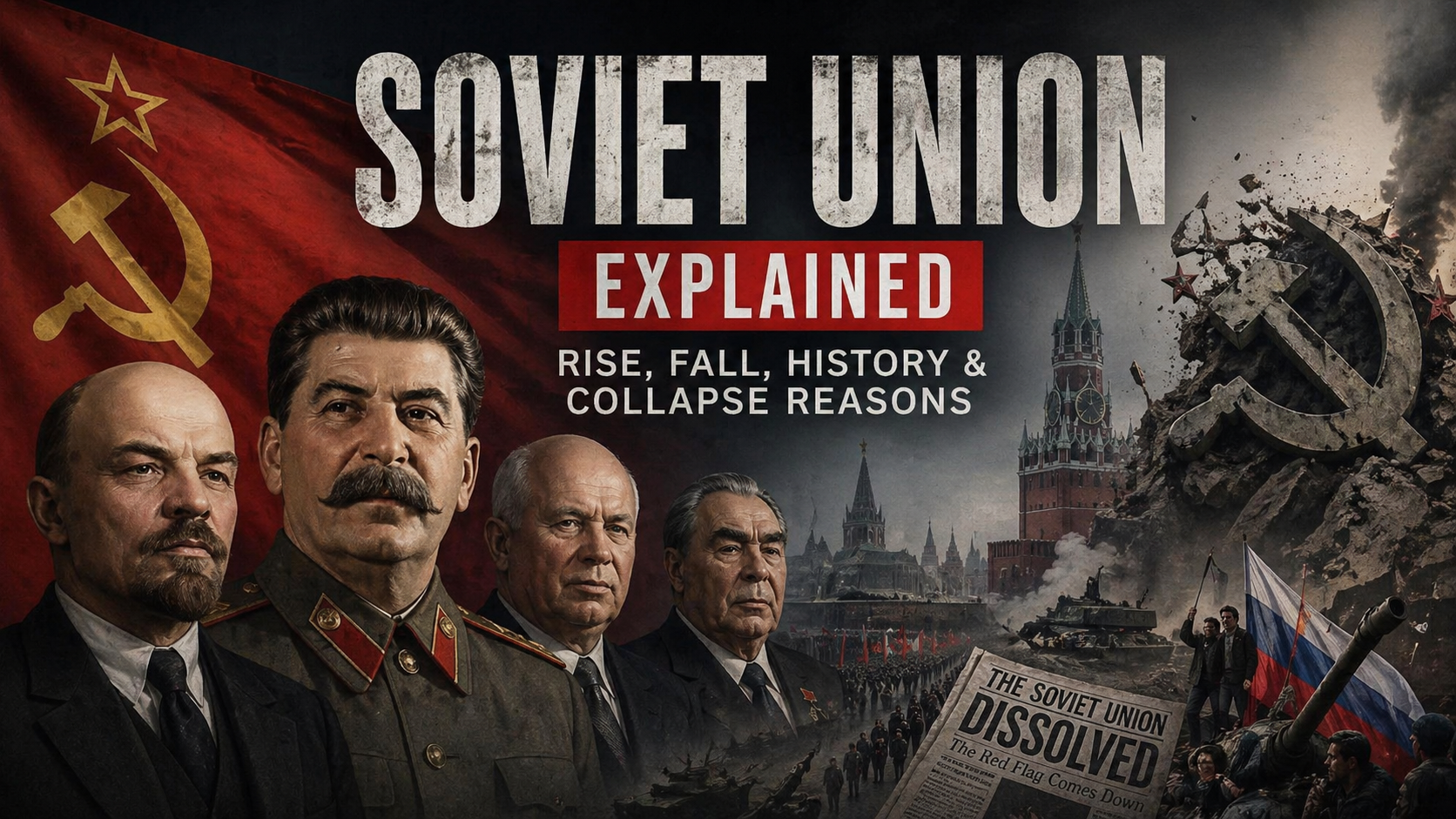
A definitive, deeply researched guide to understanding the Soviet Union rise and fall — from the Bolshevik Revolution of 1917 to the dramatic collapse of the USSR in 1991, its leaders, ideology, Cold War battles, and lasting global legacy.
The Soviet Union was a powerful country. It was also called the Union of Soviet Socialist Republics. The Soviet Union was one of the important countries in the 20th century. The Soviet Union was really big. It went across 11 time zones. The Soviet Union covered a lot of land. It covered one-sixth of the land on Earth. The Soviet Union had an impact on the world. It affected politics and economics and culture. The Soviet Union existed for over 69 years. The Soviet Union. Then it became very powerful. The Soviet Union had disagreements with the West. The Soviet Union was very different from the West. The Soviet Union eventually collapsed in 1991. This collapse still affects the world today. This guide will tell you about the Soviet Union. It will tell you about the Soviet Unions history. It will start with the Soviet Unions birth. End, with the Soviet Unions breakdown.
What Was the Soviet Union? — USSR Full Form and Basic Overview
The USSR full form is Union of Soviet Socialist Republics. In simple terms, the Soviet Union was a federation of 15 republics (at its peak) governed under a single communist party — the Communist Party of the Soviet Union (CPSU). It existed from 1922 to 1991.
The USSR was not just Russia. It was a vast multi-ethnic empire that included present-day countries like Ukraine, Kazakhstan, Georgia, Armenia, Lithuania, and many more. The capital was Moscow, and the official ideology was communism — a system where the state owns all property and controls the economy.
In simple language: The Soviet Union was a giant communist country, made of 15 republics, led by Russia, and it competed with the United States for world dominance during the Cold War.
How the Soviet Union Was Formed — The Bolshevik Revolution (1917)
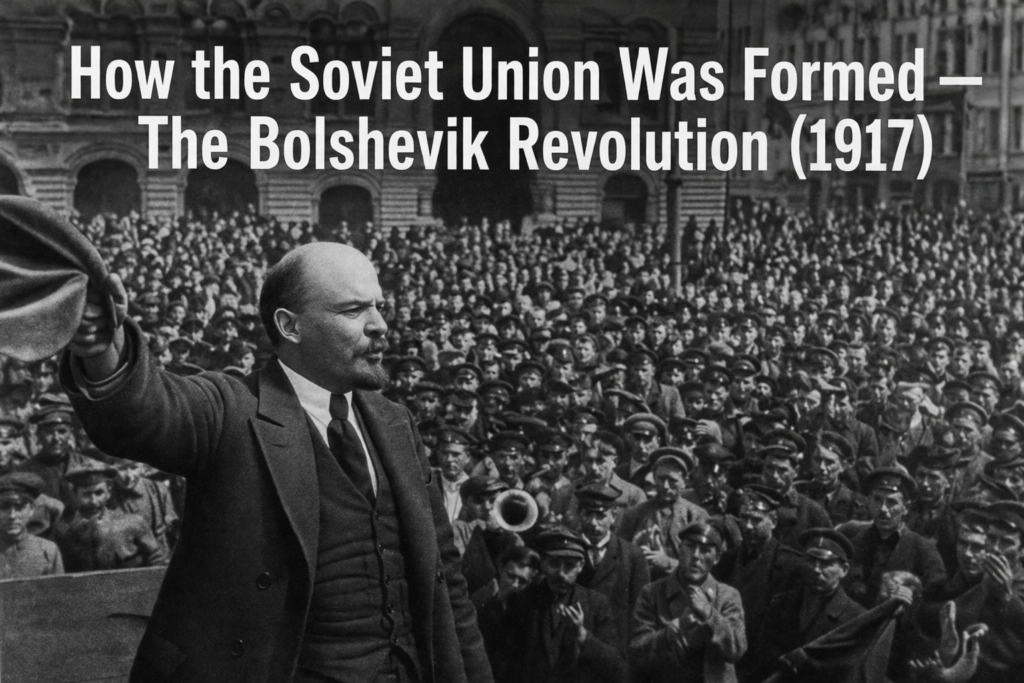
To understand how the Soviet Union was formed lets go back to Russia in the 1900s. At that time Russia was an empire ruled by Tsar Nicholas II but it was in big trouble. Most people were very poor while a small group of people controlled almost everything.
World War I made things really bad for Russia. Many soldiers. There were not enough foods. People got very angry. Started protesting. In February 1917 many people protested that Tsar Nicholas II had to step down. A new government took over. They kept fighting in the war, which made things even worse.
Then Vladimir Lenin and his group, the Bolsheviks took action. Lenin was a revolutionary who believed in Marxism. In October 1917 the Bolsheviks took over the government by force. This event is called the October Revolution or the Bolshevik Revolution. It changed the world a lot.
Lenin made promises to the people: “Peace, Land and Bread.” He took Russia out of World War I gave land to the people and started building a country. There was an violent war, between the Bolsheviks, who were called the Red Army and those who did not want communism, who were called the White Army. The Bolsheviks won this war. On December 30 1922 the Soviet Union officially started.
What is NATO & How It Works: Full Overview
Soviet Union rise and fall Timeline — Key Events (1917–1991)
Soviet Union Leaders List — From Lenin to Gorbachev
The Soviet Union leaders list shows just how dramatically leadership style shifted over seven decades:
Soviet Union Ideology — Communism Explained Simply
The Soviet Union believed in communism, which is based on the ideas of Karl Marx and Friedrich Engels. The main idea of communism is that society should not have classes and nobody should own anything just for themselves. The government should be in charge of everything that makes things, like factories and farms. It should share everything equally among the people.
In practice the Soviet Unions communism meant:
- The state owned all land, factories, and businesses
- The Communist Party was the only legal political party
- Central planners (not the market) decided what to produce, how much, and at what price
- Citizens had guaranteed housing, healthcare, and education — but very limited political freedoms
- Dissent, free press, and religious practice were heavily suppressed
The Soviet model of communism vs capitalism was the defining ideological battle of the 20th century — with the USSR representing the former and the United States representing the latter.
Soviet Union Countries — The 15 Republics
At its height, the Soviet Union consisted of 15 republics. After dissolution in 1991, each became an independent nation
Russia was by far the largest and most dominant republic — contributing the most to military power, industry, and political control. The Soviet Union vs Russia difference is simple: Russia was one republic within the USSR, but it was the most powerful. Today’s Russia is the primary successor state.
Soviet Union Economy — Strengths and Weaknesses
The Soviet Union economy was one of central planning economies — where the government, rather than market, controlled all the economic affairs of the country. It possessed many commendable features, but at the same time it also exhibited a number of terrible shortcomings.
Strengths
The economy of the USSR developed at such an amazing pace that the agricultural country became an industrial superpower within just two decades, which came under Stalin’s five-year plan. Soviet industries became the second largest after those of America. Their military-industrial complex was equally powerful, rivaling those of the West. They provided free education and healthcare facilities.
Weaknesses
the Soviet economy managed to develop industrially but proved incompetent in meeting the need for consumer products for its people. Lack of innovation, inflexibility, and the unresponsiveness of central planning to changing needs resulted in the inability of the Soviet economy to provide enough food and basic necessities to its people. In the last days of its existence, the Soviet economy was stagnating, while others were prospering.
Military expenditure comprised 15-25% of their GDP.
Soviet Union vs USA — The Cold War Explained
The Cold War was an intense rivalry between the Soviet Union and the United States from 1947 to 1991. The name “Cold War” refers to the fact that these two nations never engaged in any form of direct military conflict; otherwise, the use of nuclear weapons could have resulted in total extinction.
| Dimension | Soviet Union (USSR) | United States (USA) |
|---|---|---|
| Ideology | Communism | Liberal Capitalism & Democracy |
| Economy | State-planned | Free market |
| Alliance | Warsaw Pact / Eastern Bloc | NATO / Western Bloc |
| Nuclear arsenal (peak) | ~45,000 warheads | ~32,000 warheads |
| Space milestone | First satellite, first human in space | First Moon landing |
| Proxy wars | Korea, Vietnam, Afghanistan | Korea, Vietnam, Central America |
| Outcome | Dissolved 1991 | Emerged as sole superpower |
The major flashpoints during the Cold War between the USSR and USA were the Berlin Blockade (1948), Korean War (1950-1953), Cuban Missile Crisis (1962), Vietnam War, and Soviet-Afghan War 1979
The Eastern Bloc — Soviet Satellite States
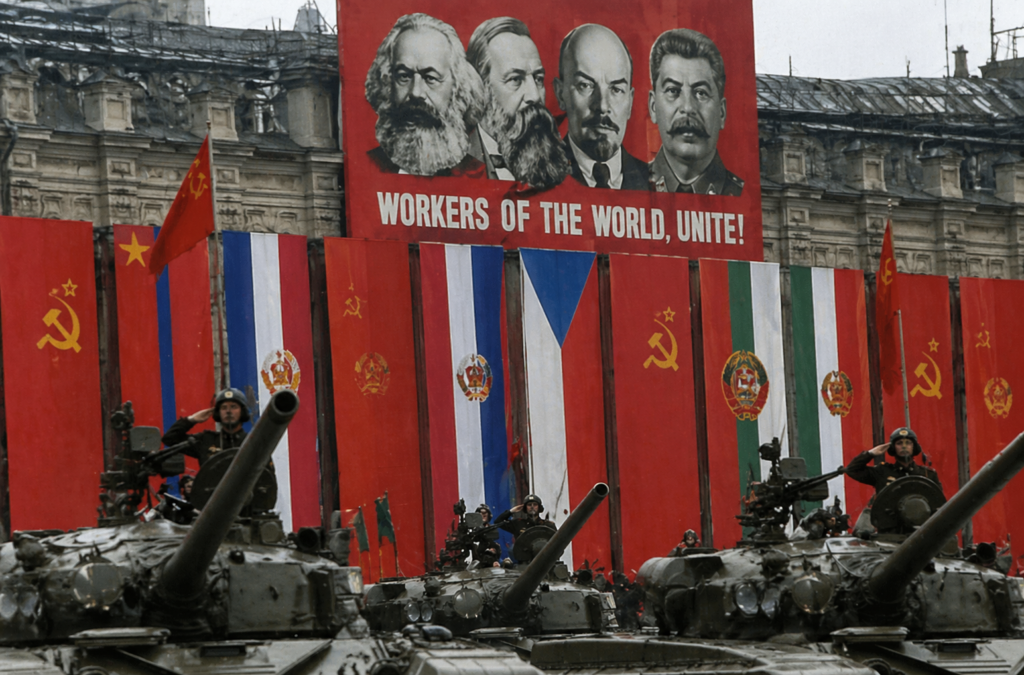
Beyond its 15 republics, the Soviet Union maintained tight control over the Eastern Bloc countries — a group of Central and Eastern European states that adopted communist governments under Soviet influence after World War II.
These countries included Poland, East Germany, Czechoslovakia, Hungary, Romania, Bulgaria, and Yugoslavia. While technically independent nations, they were expected to follow Soviet political and economic models. Soviet tanks crushed reform movements in Hungary (1956) and Czechoslovakia (1968), demonstrating Moscow’s willingness to use force to maintain control.
The Berlin Wall, built in 1961, became the most visible symbol of the Iron Curtain — the ideological and physical divide between the communist East and the capitalist West.
Joseph Stalin — The Iron Fist of the Soviet Union
oseph Stalin was in charge of the Soviet Union from 1924 to 1953. That’s thirty years. He made the USSR a superpower. Many people suffered.
Stalin did things, such, as:
- Collectivization: Farms were expropriated and turned into state collectives. Millions starved to death due to ensuing famine, including the man-made Ukrainian famine known as Holodomor (1932-33).
- Industrialization: The five-year plan brought the Soviet economy from an agrarian society to an industrial superpower.
- the Great purge (1936-1938): Massive execution and arrest of potential enemies by Stalin; among others, it included military, party members, and citizens. It is estimated that more than 750,000 were killed.
- World War II leadership(WWII): Stalin directed the Soviet Union to its victory in World War II against Nazi Germany at the cost of more than 26 million Soviet lives – the largest casualty figure in WWII. It is clear that Stalin is still a highly controversial figure – loved and revered by some in Russia due to his wartime efforts and modernization of the nation.
Mikhail Gorbachev — Glasnost and Perestroika
When Gorbachev took office in 1985 he found himself in charge of a country that was in trouble. The Soviet economy was not doing well the Soviet army had lost in Afghanistan. People were really unhappy. To fix this Gorbachev came up with two ideas that nobody had tried before:
Glasnost (Openness)
Gorbachev introduced the policy of Glasnost to give people more freedom to say what they think and to make the government more transparent. For the time people in the Soviet Union could speak out against their government read news that was not biased and learn about the bad things that happened when Stalin was in charge. This was a deal but it also made a lot of people angry and the Communist Party could not control them.
Perestroika (Restructuring)
Gorbachev started Perestroika to change the way the Soviet economy worked by introducing market reforms and giving power to local leaders.. Even though it sounded like a good idea Perestroika was not done well and it caused a lot of problems and shortages as the old system fell apart and a new one did not take its place.
Gorbachev wanted to save the Soviet Union by making changes. The results of Glasnost and Perestroika were disastrous for the Soviet Union. When the government stopped censoring everything, nationalist movements in the Soviet republics started to gain strength. One, by one the republics declared that they were independent. Gorbachev and his policies of Glasnost and Perestroika could not stop this from happening. The Soviet Union was falling apart. Gorbachevs reforms were a big part of the reason why. Glasnost and Perestroika changed the Soviet Union forever.
Why Did the Soviet Union Collapse? — All Reasons Explained
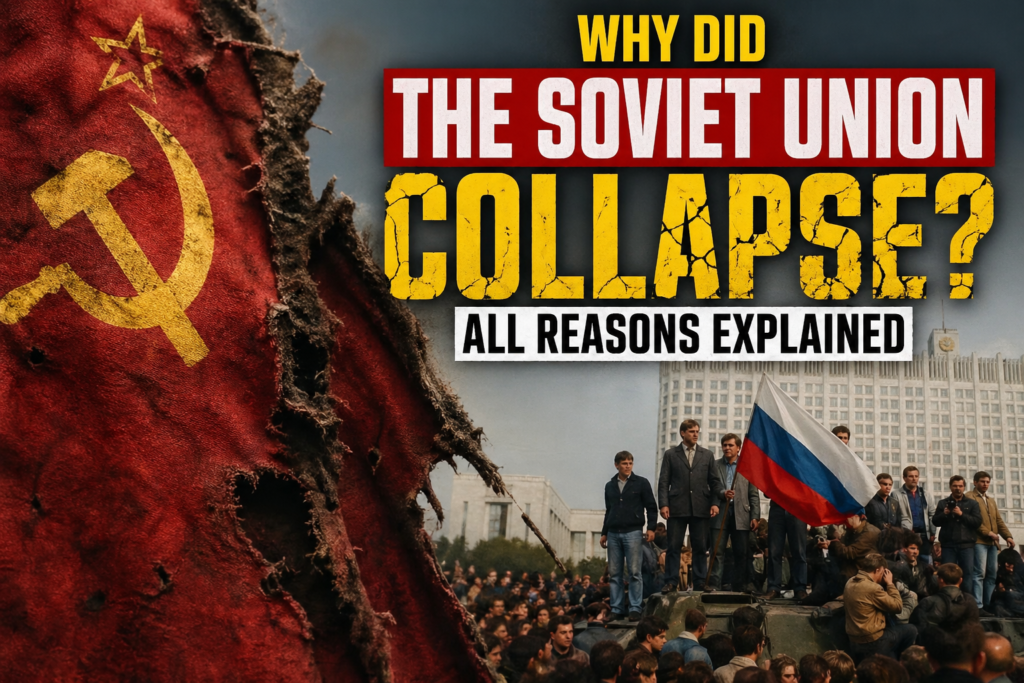
The Soviet Union fell apart and it was not because of one thing. It happened because of problems that built up over decades and finally reached a point where they could not be fixed. Here are the main reasons why the Soviet Union collapsed:
1. Economic stagnation (Zastoi)
By the 1970s and 1980s the Soviet economy was not doing well. It was a time called Zastoi, which means stagnation. The economy was not growing like it used to. People did not have things to buy. There was a lot of corruption. The Soviet system of controlling the economy was not working well as the economies of Western countries. When the price of oil went down in the 1980s the Soviet Union made money from selling oil, which made things even worse.
2. The war in Afghanistan
The Soviet Union invaded Afghanistan in 1979. This war became a big problem for them. It lasted for over a decade. Cost many Soviet lives. The war also cost a lot of money. Made the military very unhappy. People in the Soviet Union and in countries did not like the war.
3. Arms race Exhaustion
The Soviet Union was competing with the United States to see who could build the weapons. This cost a lot of money and the Soviet Union could not afford it. When the United States started spending more money on weapons including a program called Star Wars the Soviet Union could not keep up.
4. The Chernobyl disaster
In 1986 there was an accident at a nuclear power plant called Chernobyl. This accident showed everyone that the Soviet system was not working well and that it was hiding problems. The Soviet people were especially upset when they found out what had happened.
5. Nationalist Movement
When the Soviet Union started to allow freedom people in different parts of the country started to want to be independent. The Baltic states, which are Estonia, Latvia and Lithuania were the first to want to be free. Soon many other parts of the Soviet Union also wanted to be independent.
6. Gorbachev’s reforms backfired
Gorbachev, the leader of the Soviet Union tried to make some changes to fix the economy and the government.. These changes did not work and they made things worse. He allowed people to say what they thought. This also meant that people could criticize the government. He did not use force to keep the country which allowed the different parts of the Soviet Union to become independent.
7. Fall ofThe Berlin Wall
In 1989 the Berlin Wall, which separated East and West Germany was torn down. This meant that the Soviet Unions control over Eastern Europe was ending. Many people in Eastern Europe and in the Soviet Union were very happy about this. It gave them hope for a better future.
8. August coup (1991)
In 1991 some people, in the government tried to take control of the country from Gorbachev.. They failed and this meant that the Soviet Union was truly coming to an end. On December 25 1991 Gorbachev. The Soviet flag was taken down from the Kremlin for the last time. The Soviet Union was no more.
Key Highlights — Soviet Union at a Glance
- Founded: December 30, 1922 | Dissolved: December 25, 1991
- Duration: 69 years
- Total republics at dissolution: 15
- Capital: Moscow, Russia
- Total land area: 22.4 million km² — largest country in history
- Peak population: ~293 million
- Official ideology: Marxism-Leninism (Communism)
- Nuclear arsenal (peak): ~45,000 warheads
- Leaders: Lenin → Stalin → Khrushchev → Brezhnev → Andropov → Chernenko → Gorbachev
- Successor states: 15 independent nations, including Russia, Ukraine, Kazakhstan
Soviet Union vs Russia — What’s the Difference?
There exists confusion between the Soviet Union and Russia among many individuals. The following is the difference between the two:
- The Soviet Union (USSR) was a union of 15 republics. Russia was one of the republics that made up the federation.
- Russia predates the Soviet Union, and Russia continues to exist despite the disintegration of the Soviet Union.
- The Soviet Union was controlled by the Communist Party. Russia is a federal republic.
- The citizens of the Soviet Union were considered Soviet regardless of their ethnic backgrounds. However, the citizens of contemporary Russia are citizens of the Russian Federation.
- The Russian Federation took over the UN Security Council membership, nuclear weapons, and foreign debts from the Soviet Union.
Global and Economic Impact of Soviet Collapse
The Soviet Union breaking apart was a big deal for the world. The effects of this are still being felt today.
Political Impact
The United States became the superpower in the world. This lasted for a while until the mid 2000s. The North Atlantic Treaty Organization or NATO moved east. Took in countries that used to be part of the Eastern Bloc and even some that used to be part of the Soviet Union. It seemed like the idea of democracy and capitalism had won, at least for a while. This is what Francis Fukuyama called the “end of history”.
Economic Impact
The countries that came after the Soviet Union had a very hard time with their economies. Russias economy got a lot smaller it fell by 40 percent in the 1990s. When they privatized everything fast it created a group of very rich people. A lot of people got poor. Did not have jobs across the old Soviet Union. After a while the economies started to get better. It was not the same in every country.
Security and Nuclear Impact
When the Soviet Union broke apart it created a problem with nuclear security. Ukraine, Belarus and Kazakhstan got weapons from the Soviet Union but they all eventually gave them to Russia because other countries were putting pressure on them. This was a concern and it affected how countries talked about controlling weapons for a long time.
Cultural and Social Impact
The end of the Soviet Union created a lot of confusion about who people were and where they belonged. New countries had to figure out who they were. Some people found themselves on the side of the border. There were fights in Nagorno-Karabakh, Transnistria, Georgia and eventually in Ukraine. These fights started because of the way the borders were drawn when the Soviet Union was still together. The Soviet Union breaking apart was a big deal for the world. The Soviet Union had an impact, on the world.
Soviet Union in 2025 — Its Legacy and Relevance Today
Even nearly four decades after the dissolution of the Soviet Union, its impact can be felt today. In fact, Russian President Putin himself openly romanticizes the Soviet past, attempts to expand influence in the former Soviet republics, and uses Cold War rhetoric to justify his foreign policies, such as the 2022 invasion of Ukraine.
The war in Ukraine is one example of how the consequences of the fall of the USSR persist till today in the form of identity and border disputes. By 2025, geopolitics in the territories of the Soviet Union will still play a key role in international affairs.
It goes without saying that the Soviet Union had left behind an impressive intellectual legacy as well. Questions concerning socialism and capitalism, centrally planned economies and markets, social collectivism and individual freedoms will continue to define the political conversation everywhere in the world.
Sector-Wise Impact — Science, Military, and Space
Science and Technology
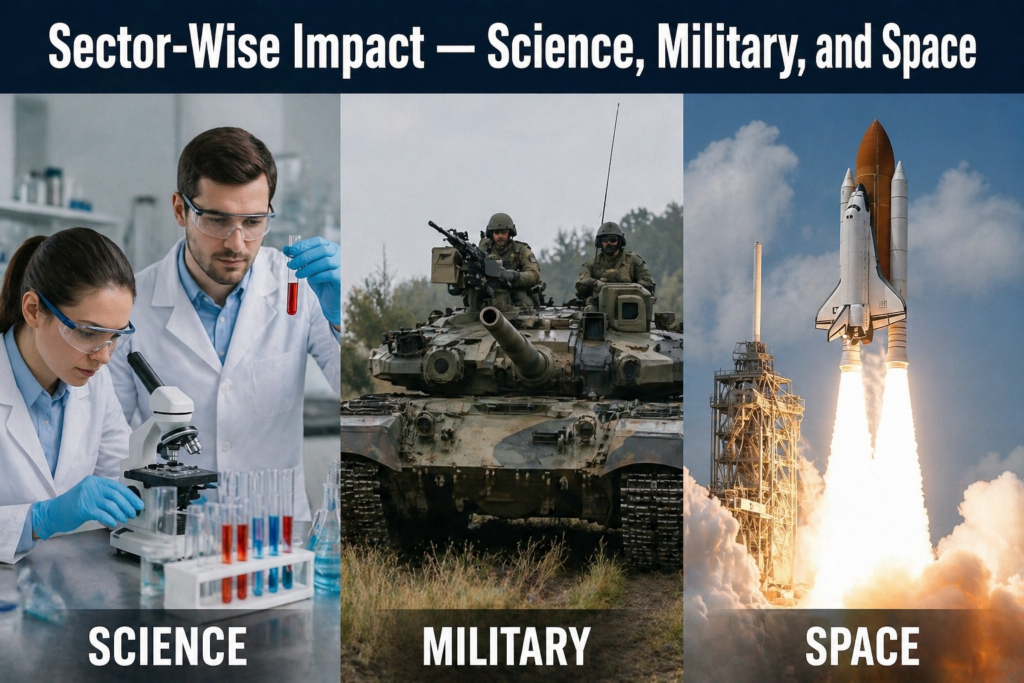
The Soviet Union did things in science and technology. They put the artificial satellite, Sputnik into space in 1957. They also sent the man, Yuri Gagarin into space in 1961. They did a lot of research on nuclear energy. The Soviets had famous mathematicians, physicists and chess players that people all over the world admired.
Military Strength
The Soviet Union had a powerful military. They had five million soldiers, thousands of weapons and a big spy network called the KGB. Their weapons, like the AK-47 rifle were famous over the world.
Education and Health Care
The Soviet Union made sure almost everyone could read and write. They also made sure everyone had access to healthcare. People, in the Soviet Union lived a time.. During a period of slow progress this got a lot worse.
Future Outlook — Can the Soviet Model Return?
The political reality of the USSR no longer exists — and indeed, there is widespread agreement among political scientists that the resurrection of the USSR as a state entity is an impossible scenario. Nevertheless, foreign policy conducted by Russia since Putin came to power includes the establishment of alternative integration regimes like the Eurasian Economic Union (EAEU) which have something in common with Soviet-era economic integration among the former republics.
There is no doubt that the appeal of socialist ideology remains relevant; in Latin America, Africa, and some Asian countries, socialist economics continues to gain considerable approval. Nonetheless, there are virtually no supporters left of the particular Soviet political system that featured one-party communist rule and central economic planning.
The relevant issue here is not whether or not the USSR will be resurrected, but rather how its former constituent states will cope with their challenging transition period after the Soviet collapse.
FAQ — Soviet Union: Frequently Asked Question
1. What is the full form of USSR and what does it mean?
The USSR full form is Union of Soviet Socialist Republics. It was a communist federation of 15 republics in Eurasia, dominated by Russia, which existed from 1922 to 1991. The “Soviet” refers to councils (soviets) that were the basic unit of communist political organization.
2. How many countries were in the Soviet Union?
The Soviet Union consisted of 15 republics. After the USSR collapsed in 1991, all 15 became independent nations — including Russia, Ukraine, Belarus, Kazakhstan, Georgia, Armenia, Azerbaijan, and the three Baltic states (Estonia, Latvia, Lithuania).
3. Why did the Soviet Union collapse (USSR ka collapse kyu hua)?
The USSR collapsed due to a combination of factors: economic stagnation, the costly Afghan War, the impossible burden of the Cold War arms race, Chernobyl’s exposure of systemic failures, rising nationalist movements across the republics, and Gorbachev’s reforms (Glasnost and Perestroika) which unintentionally accelerated the disintegration.
4. What is the difference between Soviet Union and Russia (Soviet Union vs Russia)?
The Soviet Union was a multi-national federation of 15 republics, of which Russia was just one (albeit the largest). The USSR was governed by the Communist Party; modern Russia is a federal republic. Russia is the primary successor state to the USSR, inheriting its UN Security Council seat and nuclear arsenal.
5. Who created the Soviet Union and when was it formed?
Vladimir Lenin and the Bolshevik Party created the foundation for the Soviet Union through the October Revolution of 1917. The USSR was officially founded on December 30, 1922, when four Soviet republics signed the Treaty on the Creation of the USSR.
6. When did the Soviet Union collapse (Soviet Union kab toot gaya)?
The Soviet Union officially dissolved on December 25, 1991, when Mikhail Gorbachev resigned as president and the Soviet flag was lowered over the Kremlin. The formal dissolution agreement was signed on December 8, 1991, by the leaders of Russia, Ukraine, and Belarus.
7. What were Glasnost and Perestroika and how did they contribute to the Soviet collapse?
Glasnost (openness) and Perestroika (restructuring) were reform policies introduced by Gorbachev in 1985–86. Glasnost allowed freedom of speech and transparency, unleashing suppressed nationalist and democratic movements. Perestroika attempted to reform the economy but created chaos instead. Together, these reforms destabilized the Soviet system rather than saving it, accelerating the USSR’s dissolution.