Oil Prices Surge Worldwide After Iran Rejects US Peace Plan, Brent Hits $107
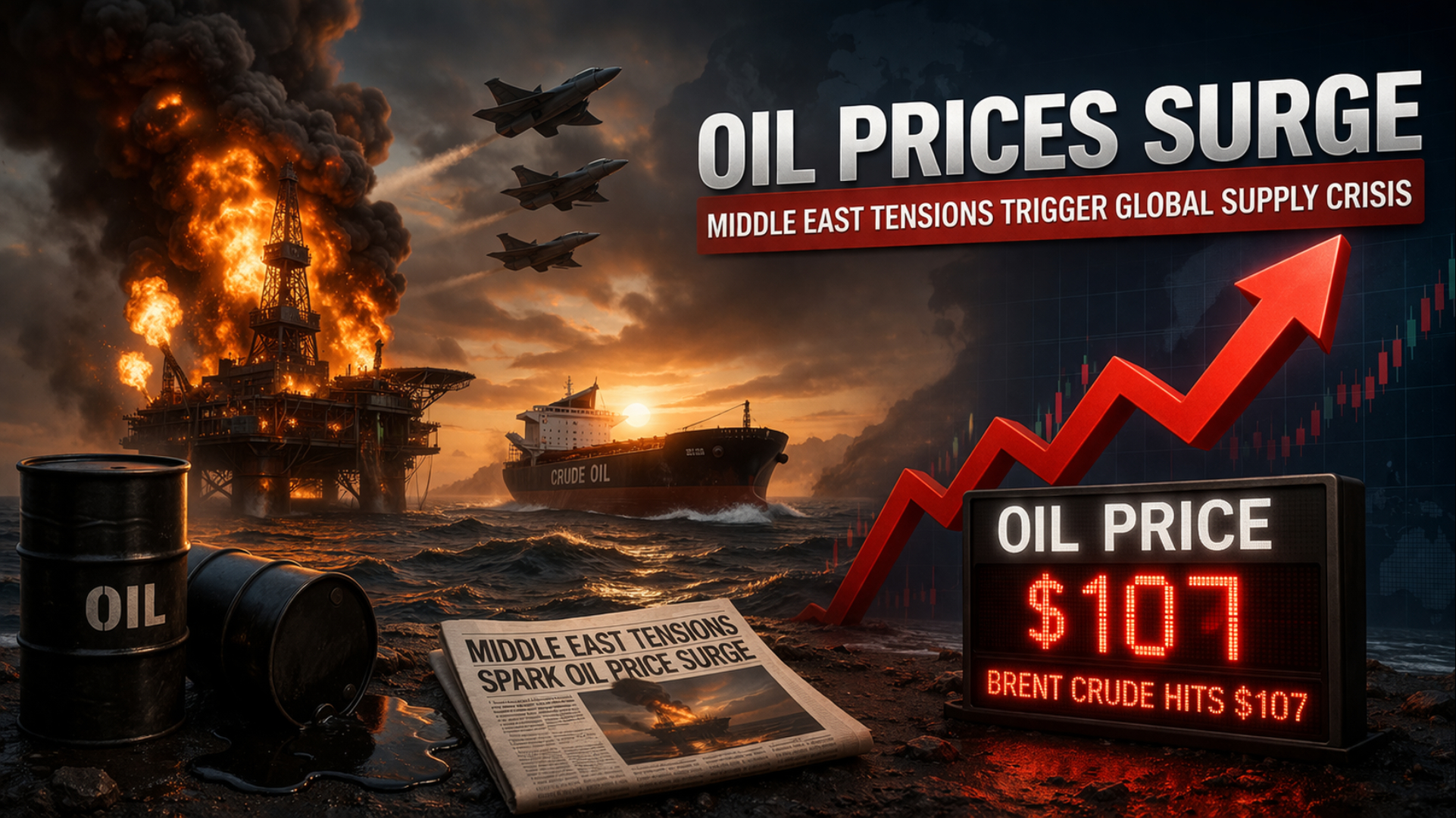
However, Oil Prices Surge Worldwide have registered a steep increase on Thursday, March 26, 2026, after Iran formally rejected a 15-point peace plan presented by the United States, thereby destroying all hopes of a ceasefire in the conflict. Brent crude oil prices have risen to $107 per barrel, whereas West Texas Intermediate oil has risen to $94 per barrel, which analysts claim instantly added a massive “war premium” to oil prices. The rejection was announced by an Iranian Foreign Ministry spokesperson, who called the plan “unreasonable and a violation of sovereignty.” This comes as a dramatic turn from the optimism in the energy market witnessed on Wednesday. Energy traders had earlier taken into account the possibility of peace talks and a partial opening of the Strait of Hormuz, which serves as the vital waterway through which approximately 20 million barrels daily of crude oil and LNG are transported.
A massive crude oil price increase grips global energy markets after Iran rejects a U.S. peace framework. The resulting oil supply disruption — 8 million barrels per day offline — is driving a fuel price rise worldwide and stoking inflation due to oil prices not seen in years.
Key Facts: Middle East Oil Crisis & Global Oil Prices Today — March 2026
- Oil prices surge worldwide— Brent crude at $107/bbl; up 50% year-to-date, highest since 2023
- Global oil prices todaydriven by Strait of Hormuz blockade; ~20 mb/d of exports halted
- Crude oil price increaseof $20/bbl since February 28 — IEA confirms 8 mb/d offline
- Middle East oil crisisworsens as Iran rejects 15-point U.S. peace proposal
- Oil supply disruption— Goldman Sachs calls it the “largest-ever supply shock” for crude markets
- Fuel price rise global— petrol and diesel costs up 50% year-to-date across Asia and Europe
- Inflation due to oil prices— consumer price indices spiking worldwide; CPI pressure expected to persist
- Impact of oil prices on economy— global GDP growth forecasts slashed; demand outlook revised down 640,000 b/d
The International Energy Agency (IEA), in its March 2026 Oil Market Report, confirmed that crude oil prices have surged by $20 per barrel since hostilities first erupted on February 28, briefly touching a whisker below $120 per barrel before settling around $92–$107. The agency confirmed that disruptions to tanker movements through the Strait of Hormuz have left producers across the Gulf region reducing or fully shutting in production, as on-shore storage tanks fill to dangerous capacity levels.
“Oil surplus was visible in January data and is likely to persist — but the Strait of Hormuz crisis has overridden all market fundamentals.”
— Natasha Kaneva, Head of Global Commodities Strategy, J.P. Morgan
Goldman Sachs, in a note published this week, raised its full-year Brent crude oil price forecast to an average of $85 per barrel for 2026, up from a prior estimate of $77, describing the Strait of Hormuz disruption as the largest-ever supply shock in the history of the global crude market. West Texas Intermediate was revised upward to $79 from $72 for the year. Analysts at TD Securities warned that the oil price shock is unlikely to prompt aggressive action from the U.S. Federal Reserve, which is expected to remain in a “wait and see” mode.
Iraq, which is the second-largest crude producer in OPEC, has experienced a dramatic slump in production levels. Storage tanks in Iraq are currently running at high and critical levels. This information is based on reports obtained from three Iraqi energy officials interviewed by Reuters. On the other hand, Ukrainian strikes using drones have halted 40% of Russia’s oil exports. This includes damage to the Kirishinefteorgsintez refinery. This refinery is one of Russia’s largest. These two events have caused a shockwave in the global energy market.
According to the U.S. Energy Information Administration (EIA) data, Brent crude oil prices were settled at $94 per barrel on March 9. This is an increase of about 50% from the beginning of 2026. This is also the highest price recorded since September 2023. Current projections by the EIA indicate that prices will remain over $95 per barrel for at least two months. Prices will then ease below $80 in the third quarter, depending on the duration of the conflict and a gradual recovery of Strait of Hormuz traffic.
On the stock market the rise in oil prices has caused a split. Companies like ExxonMobil and Chevron saw their stock prices go up by 1.5% on Thursday morning.. Airlines and shipping companies are struggling with very high operating costs and financial pressure.
The Pentagon is planning to send troops to the Gulf. This adds risk to the oil market.
For people around the world including in India, which imports a lot of oil higher oil prices mean higher fuel costs. This also means inflation and more pressure on the countrys finances. With oil prices over $100 per barrel, petrol and diesel prices, in Asia and Europe will likely go up more. Governments might release oil from their emergency reserves to try and help.
Oil Prices Spike & Global Economic Shock from Iran War
Impact of Oil Prices on the Global Economy
The impact of oil prices on the economy is already being seen in various important economic parameters. Economists at both the IMF and World Bank have warned that if crude oil prices sustain above $100 per barrel, they could reduce global GDP growth by 0.4-0.7 percent in 2026. Central banks are already dealing with a problem of stubborn core inflation. Now, they are also dealing with a new price spiral caused by rising crude oil prices. This is something that monetary policy cannot control.
Inflation caused by rising oil prices is rising rapidly in both developed and emerging economies. In the US, the energy segment of the Consumer Price Index (CPI) rose by 9.3 percent over the previous month in March. This is the highest one-month increase since the Ukraine war in 2022. In India, where crude oil forms over 30 percent of the total import bill, the rupee is again under pressure.
The global fuel price rise everywhere. It is really bad in Europe. In Germany and France the price of petrol is than 2.10 euros per litre. In the United Kingdom the price of fuel at the pump is the highest it has been in three years. Some airlines like Lufthansa and Air France are saying they will have to charge more for flights because the price of jet fuel is going up. This is also a problem for shipping companies. It is making things more expensive for people who buy things from other countries.
the middle east oil crisis does not get better it could mean that the price of energy stays high for a time. This could change the way countries trade with each other and how they make decisions about money. Some people who study the economy at Morgan Stanley think that the price of oil could cause another round of inflation. They are saying this because there is not oil in the world right now. The United States and some other countries are releasing some of the oil they have stored. It is not enough to make up for the oil that is missing. The global fuel price rise is a problem and the fuel price rise is getting worse. The fuel price rise is affecting countries and the fuel price rise is causing problems, for many people. The price of fuel is going up. The fuel price rise is not going away soon.