What Is a Self-Driving Car?
A self driving cars, also called an autonomous vehicle or driverless car, is a vehicle that can sense its surroundings and move from a point to another with little or no human input. The vehicle, using a combination of sensors, artificial intelligence and data processing, can interpret road conditions, pedestrians, traffic lights, and other road features, among other things, making decisions on how to drive. The idea of self-driving cars started in the 1920s.. Things really took off in the early 2000s. That’s when the US Defense Advanced Research Projects Agency or DARPA held its Grand Challenge. This event encouraged universities and companies to invest in the technology. By the 2010s big tech companies and car makers were competing to make self-driving cars a reality. For a time this was just something you saw in movies.
Today the self-driving car technology is worth hundreds of billions of dollars. It is seen as a game-changer for smart transportation systems, around the world. The self-driving car technology is leading this change.
| $556B Global AV market est. by 2026 | ~1.3M Traffic deaths globally each year |
| 94% Road crashes attributed to human error | 6 SAE automation levels (0–5) |
How Self-Driving Cars Work
Understanding how self-driving cars work requires breaking the system into three stages: perception, decision-making, and actuation. Together, these stages replicate — and in certain conditions, exceed — the capabilities of a skilled human driver.
Perception: Sensing the Environment
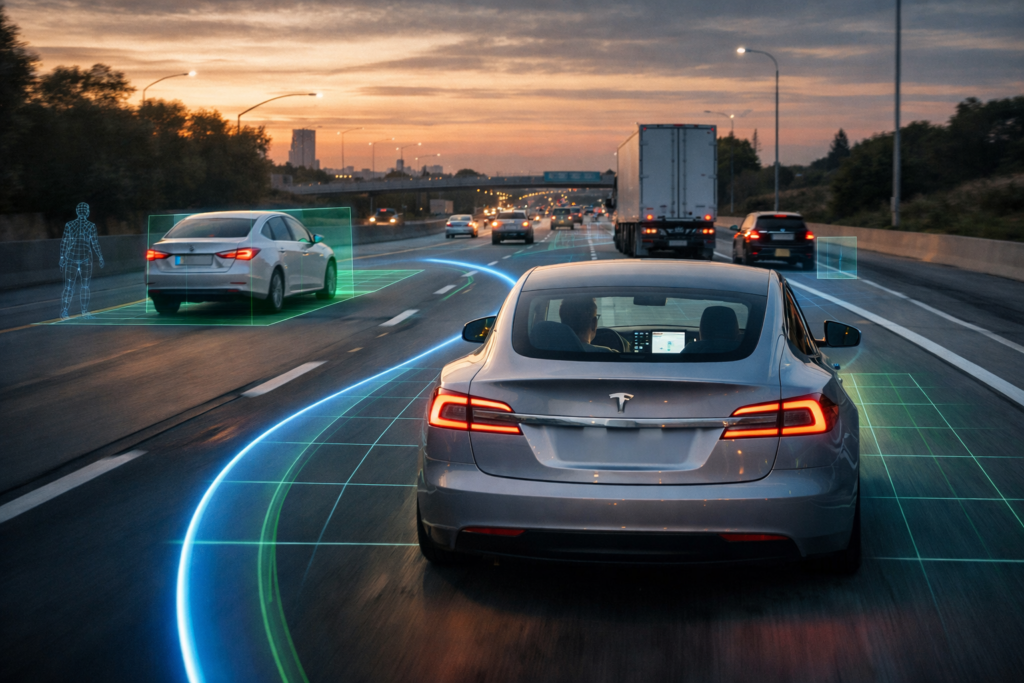
The car makes a picture of what’s around it using a bunch of different sensors that work together. The LiDAR technology in self-driving cars sends out laser pulses that hit things and bounce back which makes an accurate 3D picture of everything around the car up to 200 metres away. The radar helps figure out how fast things are moving. It works well even when it is raining or foggy which can be a problem for LiDAR. The cameras take high-quality pictures of the road including the lines on the road and the traffic lights. The ultrasonic sensors help the car when it is parking so it does not hit anything.
The self-driving car uses all of these sensors at the time, which is called sensor fusion so if one sensor stops working the car can still see what is around it. The self-driving car relies on sensor fusion to be safe. The sensor fusion in the self-driving car is really important because it helps the self-driving car know what is, around it.
Decision-Making: AI and Machine Learning
Artificial intelligence in cars is the brain of an autonomous system. Once the sensor system has established a picture of the surroundings, a perception algorithm can recognize and classify everything it sees: a cyclist, a pedestrian, a traffic cone. It can also forecast the likely path of each object over the next few seconds. A planning algorithm can then compute a path through the environment safely and efficiently, taking into account hundreds of factors from speed limits and weather conditions to the likely behavior of other vehicles. Machine learning in an autonomous vehicle allows the system to improve over time: machine learning can recognize patterns from millions of miles of data and can adapt to unusual situations: a child running after a ball into the road, a tree branch lying across the road. Deep neural networks can analyze camera and sensor information at the same time, usually within a matter of milliseconds.
Actuation: Controlling the Vehicle
The last process interprets the decisions of the AI and sends them as physical commands to the throttle, brake, and steering actuators through the vehicle’s CAN bus network. Redundancy is also built in, so that in case of a failure in the primary control pathway, backup systems will ensure continued safe operation. High-definition maps, which are sometimes pre-created with a precision of a few centimetres, provide additional information that enables the system to detect intersections and lane changes even before they come within range of the sensors.
“A self-driving car doesn’t just see the road — it comprehends it, predicts it, and responds to it dozens of times every second.”— Industry characterisation of autonomous perception systems
Level 0 to Level 5 Autonomous Cars
The Society of Automotive Engineers (SAE) defines a widely adopted six-tier framework to classify the degree of driving automation. Understanding level 0 to level 5 autonomous cars is essential for consumers, regulators, and industry stakeholders alike.
| Level | Name | Who Drives? | Real-World Examples |
| Level 0 | No Automation | Human fully in control at all times | Most cars before 2010; basic ABS, emergency alerts only |
| Level 1 | Driver Assistance | Human drives; single feature assists | Adaptive cruise control, lane-keep assist |
| Level 2 | Partial Automation | Human monitors; system controls steering + speed | Tesla Autopilot, GM Super Cruise |
| Level 3 | Conditional Automation | System drives; human must be ready to take over | Honda Legend (Japan), Mercedes Drive Pilot |
| Level 4 | High Automation | System drives in defined geographic zones | Waymo One robotaxis (Phoenix, San Francisco) |
| Level 5 | Full Automation | No human needed — ever | Not yet commercially deployed at scale |
It is, however, important to note that the majority of vehicles on public roads are at Level 1 or Level 2. Real autonomous vehicles, or driverless cars, which operate without any human oversight, are at Level 4 and Level 5 and are currently contained within geofenced pilot programs. Level 5, or full automation in any condition, anywhere, is a future technological goal.
Core Technologies Behind Autonomous Vehicles
LiDAR
LiDAR technology in self-driving cars is still one of the debated hardware choices. Traditional spinning LiDAR units are mounted on a rotating turret. They scan 360 degrees. This produces detailed point clouds. Solid-state LiDAR is a variant. It has no moving parts. This makes it more durable. It is also cheaper to mass-produce. Some manufacturers, like Tesla do not use LiDAR. They argue that a trained camera-based system can work just as well. It can do this at a lower cost. The LiDAR technology is still being discussed. Self-driving cars use LiDAR. Some people think LiDAR is not needed. A camera-based system can replace LiDAR. This is what some manufacturers think about LiDAR.
HD Mapping and Localisation
However, GPS can only provide a precision of a few meters. This is not sufficient for lane-level precision. Autonomous vehicles use a localisation algorithm that compares sensor feeds against high-definition maps. This gives the vehicle a precision of a few centimeters. This is necessary for high-speed travel and for navigating through intersections.
Edge Computing and Vehicle-to-Everything (V2X) Communication
Processing petabytes of sensor data in real time demands purpose-built compute hardware in the vehicle. Chips from NVIDIA, Qualcomm, and Mobileye are designed specifically for automotive neural network inference. Complementing on-board compute is V2X communication, which allows a vehicle to exchange data with traffic infrastructure, other vehicles, and network servers — effectively giving the car awareness that extends beyond its own sensor range.
AI, Neural Networks, and Deep Learning
Machine learning in autonomous vehicles underpins perception, prediction, and planning simultaneously. Convolutional neural networks parse camera images; recurrent networks model time-series patterns in sensor data; reinforcement learning enables simulated training of rare and dangerous scenarios that would be impractical to capture on public roads. The result is a system that can generalise to novel situations — a hallmark of truly intelligent driving behaviour.
Self-Driving Cars Pros and Cons
No technology of this magnitude is without trade-offs. A balanced look at the advantages of self-driving cars and the disadvantages of autonomous vehicles is essential for informed public debate.
| Advantages (Pros) | Disadvantages (Cons) |
| Dramatically reduced human-error crashes | Significant cybersecurity vulnerabilities |
| Mobility for elderly, disabled, and non-drivers | High development and purchase cost |
| Lower fuel consumption via optimised driving | Job displacement for professional drivers |
| Reclaimed commute time for passengers | Ethical dilemmas (trolley-problem scenarios) |
| Reduced urban congestion through platooning | Performance gaps in bad weather |
| Lower logistics and freight costs | Legal and liability ambiguity |
| Potential reduction in drink-driving fatalities | Dependence on infrastructure quality |
| Improved accessibility in rural areas | Privacy concerns from pervasive data collection |
The benefits of driverless cars are most acute in the domain of road safety technology. Because roughly 94% of serious traffic crashes globally involve human error — distraction, fatigue, impairment — a well-functioning autonomous system could, in principle, eliminate the majority of these events. The problems with self-driving cars, conversely, are more systemic: no technology company has yet demonstrated that AV systems perform as reliably in edge cases as they do in controlled conditions.
Are Self-Driving Cars Safe?
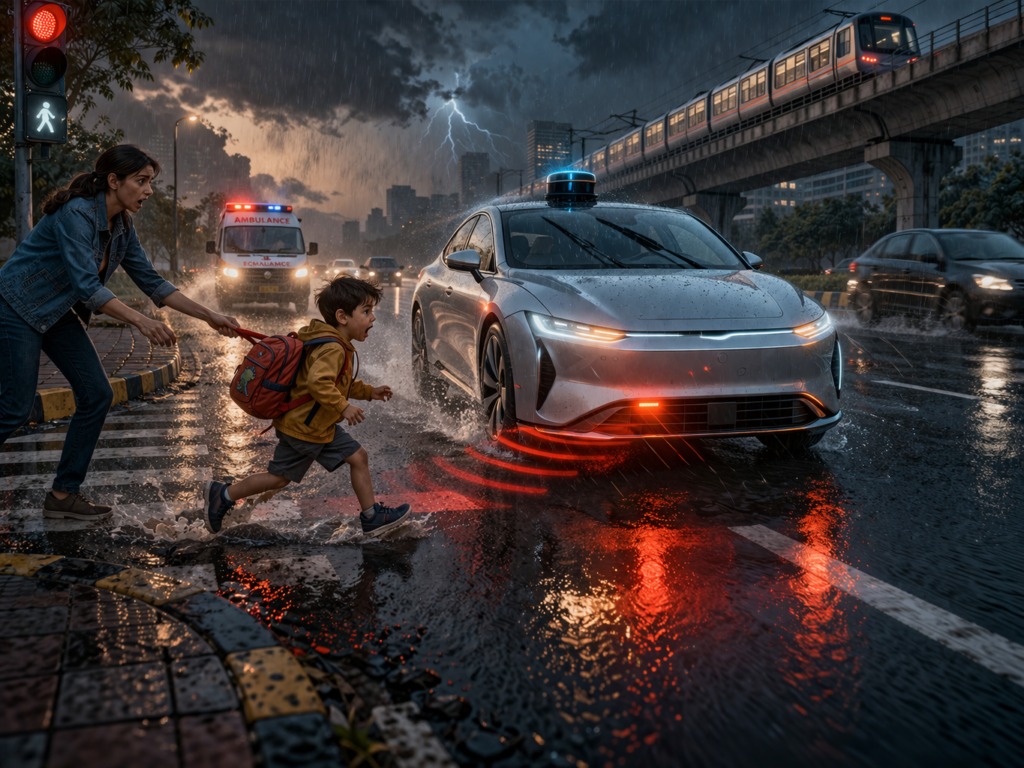
The question of whether autonomous vehiclesre safe is not a simple yes or no. There have been some accidents. Like the fatal crashes with Teslas Autopilot and the pedestrian death with an Uber test vehicle in Arizona in 2018. That make people worry about safety.
When you look at the numbers it is not so clear. Waymo says its vehicles have driven millions of miles in cities with crashes that hurt people than the average for human drivers in the United States. However some people point out that autonomous vehicles usually drive in weather and in areas that are well mapped which makes it hard to compare them to all the other drivers. Autonomous vehicles are typically driven in these conditions, which can make the comparisons a little unfair, for autonomous vehicles.
Key Safety Considerations
Sensor redundancy: Modern AV systems use overlapping sensor modalities so that a single point of failure does not compromise safety.
Ethical programming: Who is liable when an autonomous car must choose between two harmful outcomes? Regulators in the EU and US are actively drafting frameworks to address this.
Cybersecurity: A networked, software-driven vehicle is susceptible to remote attack. Automotive-grade security protocols are now a regulatory requirement in several jurisdictions.
Fail-safe mechanisms: If software detects an unresolvable situation, a safe stop sequence is triggered — a principle absent in human driving.
The consensus among researchers is that self-driving cars have the potential to be substantially safer than humans over the long run, but that the transition period — during which AVs share roads with millions of human-driven vehicles — carries its own risks and will require careful regulatory management.
Companies Working on Self-Driving Cars
The competitive landscape for self-driving car development spans technology giants, legacy automakers, and well-funded start-ups. Below are the key players shaping the sector.
| Waymo (Alphabet / Google) The pioneer behind the original Google self-driving car project, Waymo operates the world’s most mature commercial robotaxi service (Waymo One) in Phoenix and San Francisco with fully driverless rides. | Tesla Tesla self-driving technology relies on a camera-only “Tesla Vision” system. Its Full Self-Driving (FSD) software is a Level 2 system deployed across millions of vehicles, generating an unrivalled real-world training dataset. Tesla’s Robotaxi ambitions target 2026. | Cruise (GM) Operated a driverless taxi service in San Francisco before regulators suspended its permit in 2023 following a pedestrian incident. GM has since restructured and narrowed the programme’s scope. |
| Baidu Apollo China’s dominant AV platform, with thousands of robotaxi trips completed in Beijing and Wuhan. Baidu is considered one of the leading companies working on self-driving cars globally. | Mobileye (Intel) Supplies ADAS chips and systems to most major automakers. Transitioning from driver assistance to full autonomy through its REM mapping system and EyeQ chip family. | Aurora Innovation Focused on autonomous long-haul trucking in the US. Launched its commercial driverless freight service in 2024, operating on select Texas highway corridors. |
Tesla Self-Driving Technology Explained
The safety of self-driving cars is not an answer. There have been some accidents. Like the ones involving Teslas Autopilot and an Uber test car in Arizona in 2018 that killed a pedestrian. These incidents have raised concerns about how safe these vehicles are. If we look at the actual numbers the story is more complicated. Waymo has shared data that shows its self-driving cars drive millions of miles in cities without causing as injuries as human drivers do on average in the US. However some people point out that these self-driving cars usually operate in good conditions. Like clear weather and mapped-out city areas. This makes it hard to compare their safety record directly to that of drivers. Self-driving cars are driven in controlled environments, which affects their safety numbers. The safety of self-driving cars, like Waymos depends on factors.
Self-Driving Cars in India
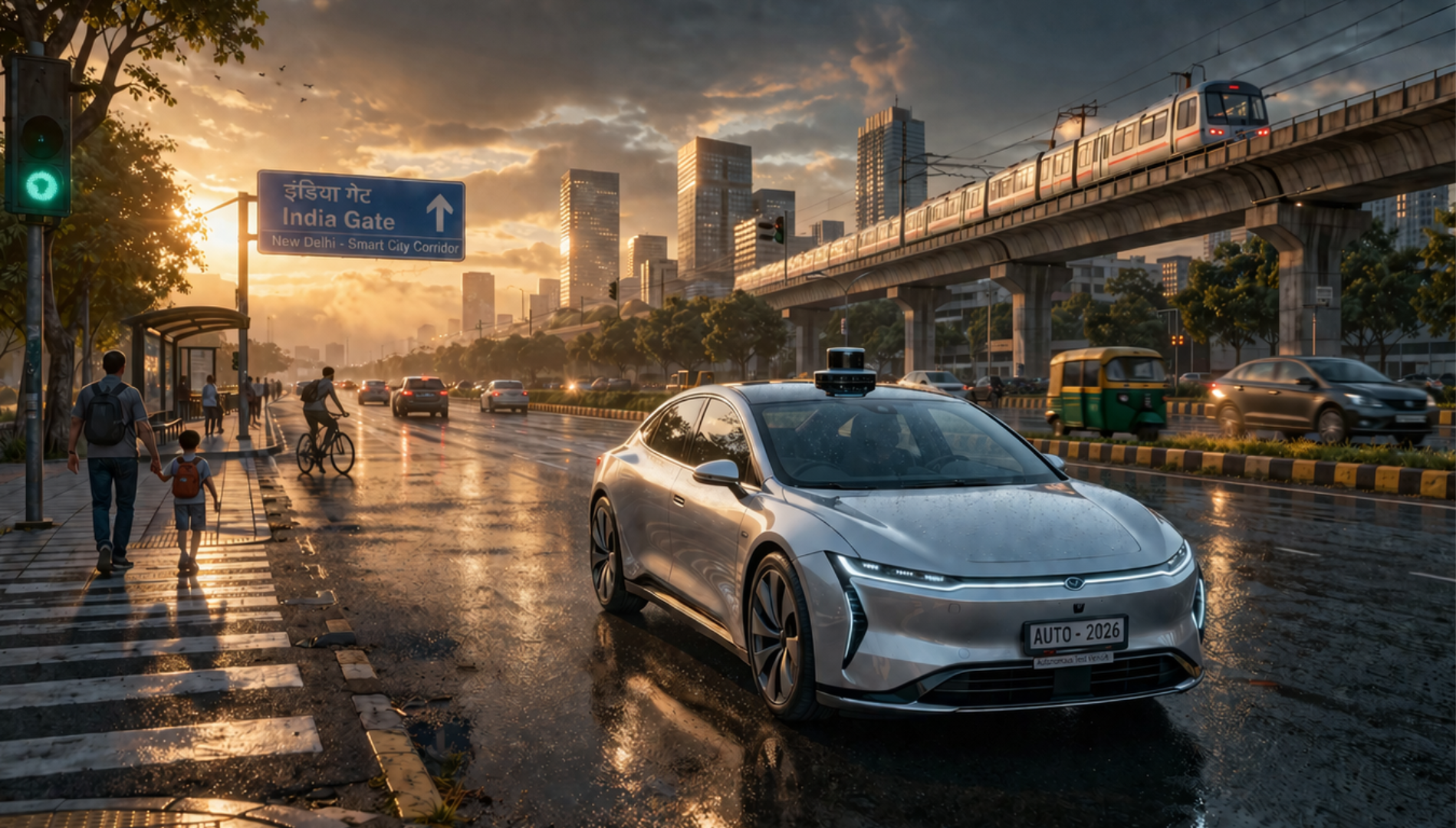
Self-driving cars in India, thus, present a great opportunity and a great challenge. The road conditions in India are perhaps some of the most complex in the world, with a mixture of cars, two-wheelers, cattle, auto-rickshaws, and pedestrians on the road, not to mention the absence of lane markers and the extremes of weather that include floods and dust storms.
Driverless cars are not currently allowed on the public roads of India without a driver. This is due to the Motor Vehicles Act, which requires a driver to be present in the vehicle. However, the Government of India has shown willingness towards a regulatory framework for AV testing. The Ministry of Road Transport and Highways has launched a draft AV policy in 2023 for developing a framework for AV testing on designated corridors.
India AV Landscape at a Glance
- Tata Motors and Mahindra are investing in ADAS features — lane assist, automatic emergency braking — bringing domestic vehicles to Level 1–2 capability.
- Ola Electric and Namma Yatri are exploring AI-assisted ride-hailing, though full autonomy remains a distant goal in the Indian context.
- IIT Bombay, IIT Madras, and IISc Bangalore are running active research programmes on AV perception systems tailored to Indian road conditions.
- Regulatory status: No commercial driverless car service operates on Indian public roads as of 2025. Testing on private or closed tracks is permissible.
Experts generally agree that a genuinely India-ready autonomous vehicle would require training on uniquely Indian datasets — something international companies have been slow to build. Domestic champions and academic institutions thus hold a strategic advantage in developing autonomous vehicles suited to the subcontinent’s conditions.
Impact of Self-Driving Cars on Society
The influence of self-driving cars on society is not just about convenience. Analysts and policymakers are contemplating major impacts on employment, economy, urban planning, insurance, healthcare, and civil liberties.
Employment and Economy
The trucking, taxi, and delivery industries combine for tens of millions of jobs worldwide. The introduction of autonomous vehicles could lead to major employment displacement. The argument for self-driving cars is that new jobs will be created in areas like autonomous vehicle software development, sensors, and fleet management. However, it is argued that older workers will be more affected.
Urban Planning and Land Use
A world where we all share driverless cars can really change how we use land in cities. We will not need much space for parking so we can use that land for homes, parks and stores instead. Cities are currently designed with cars in mind with roads and lots of parking lots and suburbs that are really spread out. These cities might need to be redesigned.. If we have driverless cars it could also make it easier for people to live far away from the city, which could make urban areas even more spread out.
Accessibility and Inclusion
One of the most humane benefits of driverless cars is people who cannot drive, people who are blind and people, with disabilities. For these people having a car is not just nice to have it is a really big deal. It can totally change their lives. Give them a lot more freedom. Driverless cars can give people with disabilities the ability to get around on their own which’s a really great thing. Urban Planning and Land Use and Accessibility and Inclusion are two areas where driverless cars can make a difference.
Data Privacy and Surveillance
An autonomous vehicle is, by definition, a data collection platform. Cameras, microphones, LiDAR, and location systems operating continuously generate detailed records of passengers’ movements, conversations, and behaviour. How this data is stored, shared, and protected is one of the central civil liberties questions of the coming decade.
The Future of Self-Driving Cars
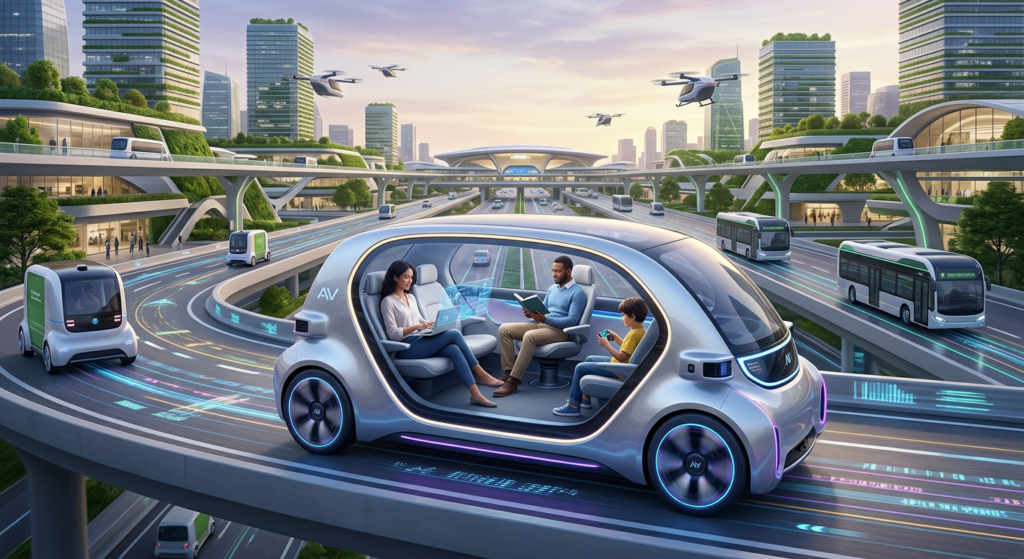
The future of self-driving cars is shaped by three converging forces: technological maturation, regulatory evolution, and shifting public acceptance.
On the technology front, compute costs are falling rapidly. The same AI processing power that required specialised hardware worth tens of thousands of dollars in 2018 can now be achieved far more cheaply, making it economically feasible to include in mass-market vehicles. Improvements in transformer-based vision models — the same architectural family powering large language models — are enabling perception systems that generalise more robustly to novel environments.
The regulatory picture is evolving at different speeds across different jurisdictions. The European Union’s Vehicle General Safety Regulation has mandated ADAS features in new vehicles from 2024. The United States operates a patchwork of state-level laws. China, aiming to lead the smart transportation system of the future, is deploying AV infrastructure at city scale. The UAE has tested driverless vehicles in Dubai’s controlled corridors.
For future mobility, the most transformative scenario is not the individually owned self-driving car but the robotaxi fleet — a shared, on-demand, autonomous ride-hailing service that makes car ownership unnecessary in dense urban areas. Waymo, Cruise, Baidu, and Zoox (Amazon) are all building toward this model. If realised at scale, the implications for road congestion, carbon emissions, and urban design would be profound.
“The transition to full autonomy will not happen overnight. It will proceed level by level, corridor by corridor, city by city — until one day, somewhere, a human will hand over the wheel for the last time.”— Industry perspective on the autonomy transition
Closer to the present day, the next step on the horizon is likely to be the deployment of Level 3 vehicles — vehicles that can drive themselves on highways but require a human to be awake — in Europe, the US, and East Asia. Beyond this, the extension of Level 4 robot taxi availability to more cities in the late 2020s is now looking more and more likely. Level 5 — full autonomy without the need for a human to be awake and aware — remains the guiding vision for the industry, and the earliest estimates for this suggest the 2030s at the very earliest.
Explore more insights on AI, innovation, and future technologies in our Technology category.
Frequently Asked Questions
What is a self-driving car?
A self-driving car is a vehicle that can drive itself. It has sensors, artificial intelligence and control systems. These help it move on roads without a person controlling it. The self-driving cars autonomy level can vary. It can be as simple, as helping the driver (Level 1).. It can be fully autonomous handling any driving situation without a person (Level 5). Self-driving cars are also called vehicles or driverless cars. They use cameras, LiDAR and radar to see their surroundings. They make decisions in time using deep learning algorithms. The self-driving car uses these to navigate The self-driving cars systems work together. They help the vehicle understand its environment. This lets the self-driving car make choices while driving.
How do autonomous cars work?
The process of how autonomous cars work is based on three main stages. First, there is perception, whereby through the use of LiDAR, radar, and camera technologies, a real-time image of the environment is developed, which is later processed through sensor fusion to obtain an accurate model of the environment. Secondly, there is cognition, whereby through the use of AI technologies, cars are able to classify objects, make predictions, and calculate a safe route. Lastly, there is actuation, whereby through the use of AI technologies, cars are able to send precise commands to the steering, acceleration, and braking systems. Additionally, there is the use of HD maps and V2X technologies.
Are driverless cars legal in India?
As of 2025, fully “driverless cars” are not legally allowed on public roads in India for commercial or personal use. The Motor Vehicle Act requires a human driver licensed to operate a vehicle on public roads. The government of India has released draft guidelines for testing AVs on specific corridors. Several domestic manufacturers are working on Level 1-2 ADAS systems. Academic institutions like IIT Bombay and IIT Madras are also conducting research on AVs for India. It is believed that it is still several years away from being approved for commercial use.
Can self-driving cars prevent accidents?
Self-driving cars can really help prevent accidents. This is because serious car crashes happen because of mistakes people make like when they are not paying attention are too tired have been drinking or just make bad decisions. If self-driving cars work properly they can avoid all these mistakes. Really reduce the number of crashes. Some companies, like Waymo are already seeing results from their self-driving cars.
Self-driving cars are not perfect yet. They can have trouble, in rain in areas they do not know well or on roads that are not normal. As self-driving cars get better and can do things on their own they will become even safer. The safety of self-driving cars will get a lot better as the technology gets better. Self-driving cars will become safer as they can do things by themselves.
Will self-driving cars replace human drivers?
In particular situations like long-haul highway trucking, city robotaxis, and airport transfers, human drivers will be replaced by autonomous vehicles in the next decade or two. However, for mass consumer use in various and complex situations, replacement of human drivers by AVs is still in the long term. This process will be evolutionary rather than revolutionary. Level 2 and 3 capabilities will be standard on new vehicles, gradually diminishing the need for human intervention in driving. Even Level 5 autonomy, where there is no need for a human driver in any situation, is predicted to be available for commercial fleets in the 2030s. However, for personal vehicles, autonomy is still in the 2040s in developed countries. It is not a question of replacement but of a handover process.