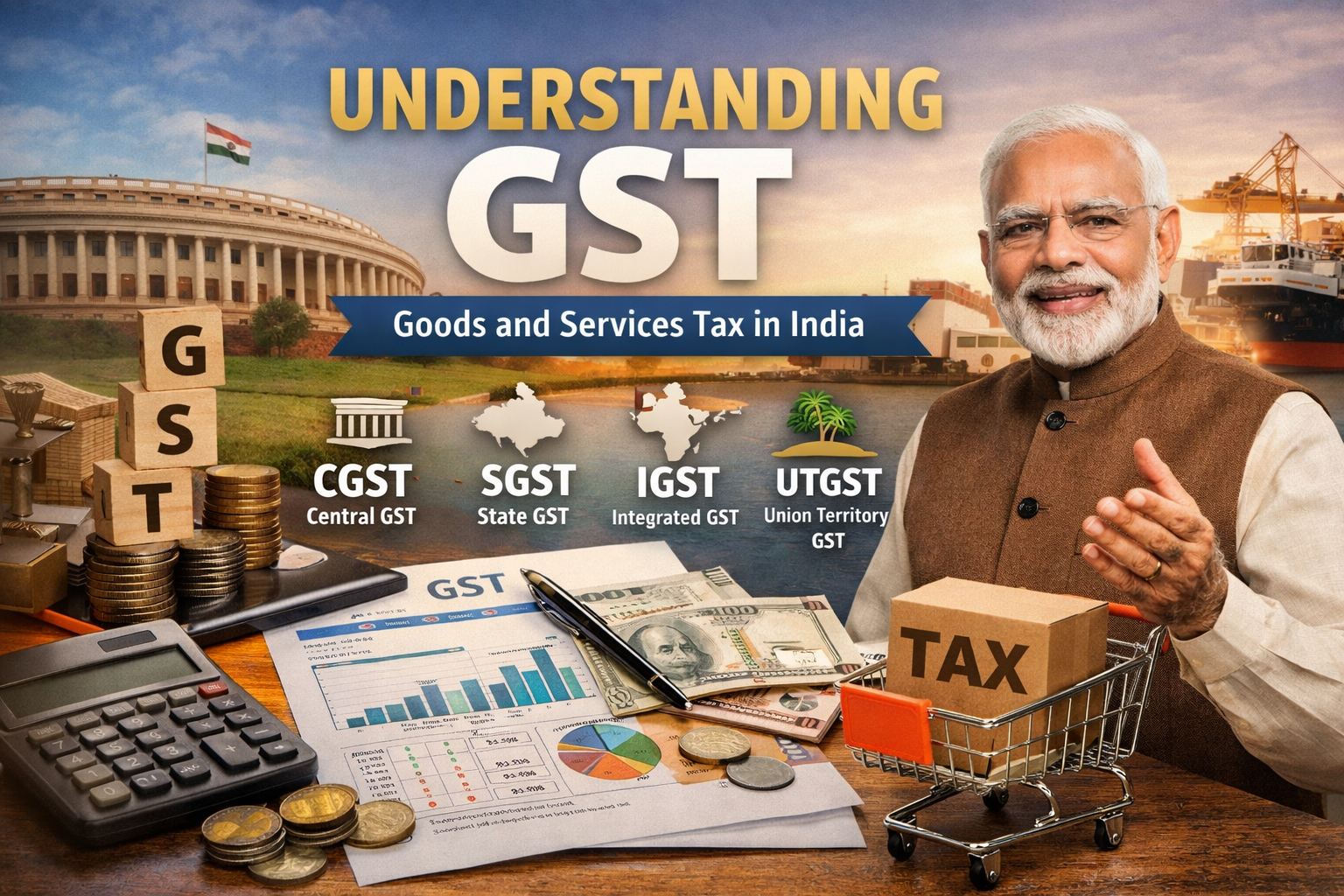
The Goods and Services Tax (GST) is a tax change, in Indias recent economic history. It was introduced to make the indirect tax system simpler. GST replaced central and state taxes with one unified tax. The GST rollout happened under the leadership of Prime Minister Narendra Modi. Since then it has changed how businesses and consumers pay taxes. This guide will explain what is GST. It will also cover how GST works in India. The GST structure will be discussed. We will look at the benefits of GST. The challenges of GST will be examined. GST matters for both businesses and consumers.
What Is GST?
Goods and Services Tax is a comprehensive indirect tax levied on the supply of goods and services in India. It replaced several earlier taxes imposed by both the central and state governments.
Before GST, India had multiple taxes such as:
- VAT (Value Added Tax)
- Service Tax
- Excise Duty
- Entry Tax
- Luxury Tax
- Octroi
These taxes often created tax-on-tax (cascading effect) and made compliance complicated.
GST introduced “One Nation, One Tax”, meaning most goods and services now fall under a unified tax structure.
When Was GST Introduced in India?
GST officially came into effect on 1 July 2017, following the passage of the Constitution (101st Amendment) Act. The reform was governed by the GST Council, which determines tax rates, rules, and policies.
The council includes:
- India’s Finance Minister (Chairperson)
- State finance ministers
- Union ministers
How GST Works in India
GST is a tax system that works in stages and the tax goes to the place where the product is sold. This means that tax is paid at every step when something is made and sold. The person who buys it last has to pay the most.
GST Supply Chain Example
Let us understand this with an example.
The GST system has steps.
Step 1: Manufacturer
- The manufacturer buys the things he needs to make something.
- He pays GST when he buys these things.
Step 2: Wholesaler
- The wholesaler buys the product from the manufacturer.
- He pays GST. He also gets some money back because he paid tax when he bought the product.
Step 3: Retailer
- The retailer buys the product from the wholesaler.
- He also gets some money back because he paid tax when he bought the product.
Step 4: Consumer
- He pays GST. He does not get any money back.
- So GST makes sure that tax is paid at every step. The same tax is not paid twice on the same product.
GST is a system because it makes sure that tax is collected at every stage but it does not make the products too expensive, for the consumer, which is the person who buys the GST products.
READ ALSO- What is UPI: How India’s Digital Payment Revolution Transformed Finance
Input Tax Credit (ITC): The Core of GST
One of the most important features of GST is Input Tax Credit (ITC). ITC allows businesses to reduce the tax they pay on output by the tax they already paid on inputs..
Example A furniture maker:
- Pays 5,000 rupees GST on buying wood
- Charges 8,000 rupees GST on selling furniture
- Final GST to be paid:
- 8,000 rupees minus 5,000 rupees equals 3,000 rupees
This system stops tax, on tax and makes things more efficient.
Types of GST in India
India has a system for collecting GST, which means that both the central government and the state governments collect tax from people. The central government and the state governments work together to collect GST in India.
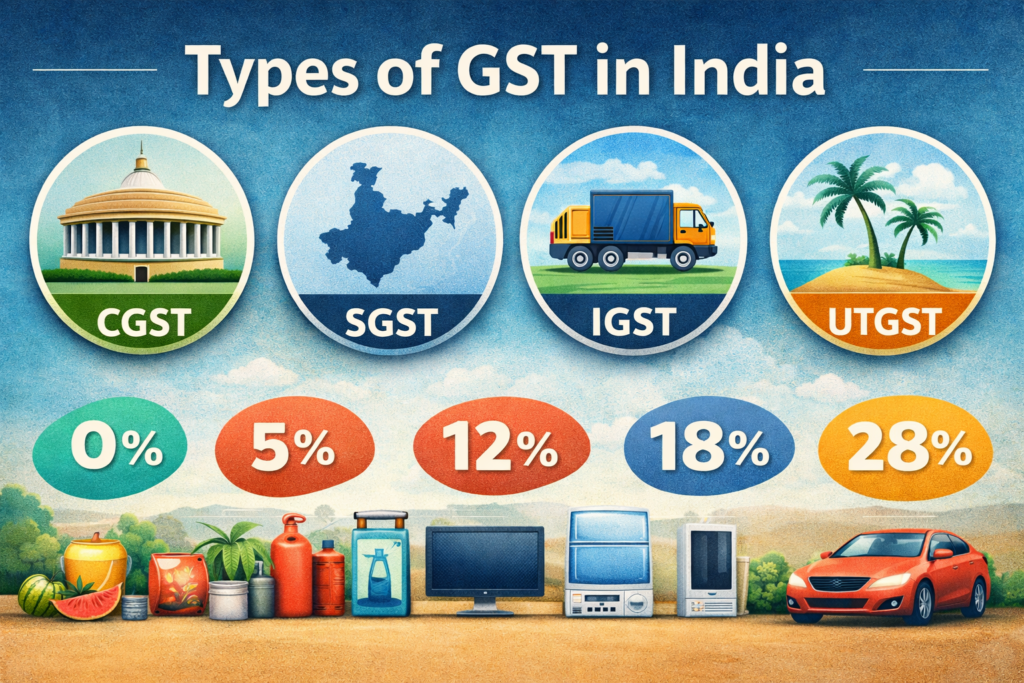
GST is collected in ways and there are four main types of GST in India.
CGST (Central GST)
This is the Central Goods and Services Tax.
The central government collects Central Goods and Services Tax when people buy and sell things within the state. For example when someone buys something from a shop in their state the central government collects Central Goods and Services Tax.
SGST (State GST)
This is the State Goods and Services Tax. The state government collects State Goods and Services Tax when people buy things from shops in their state. For example if someone buys something from a shop in Rajasthan and they are also from Rajasthan, the state government of Rajasthan collects State Goods and Services Tax.
IGST (Integrated GST)
This is the Integrated Goods and Services Tax.
The central government collects Integrated Goods and Services Tax when people buy and sell things between states. The central government also collects Integrated Goods and Services Tax when people import things from countries. For example if a company from Delhi sells something to someone in Maharashtra the central government collects Integrated Goods and Services Tax.
Then the central government shares the Integrated Goods and Services Tax with the state governments.
UTGST (Union Territory GST)
This is the Union Territory Goods and Services Tax. Union Territory Goods and Services Tax applies to some places, in India like the Andaman and Nicobar Islands and Lakshadweep.
These places do not have their governments so the central government collects Union Territory Goods and Services Tax from them.
GST Tax Slabs in India
GST follows multiple tax slabs to accommodate different product categories.
| GST Rate | Applicable Items |
|---|---|
| 0% | Essential goods like fresh food |
| 5% | Household necessities |
| 12% | Processed foods and basic products |
| 18% | Most goods and services |
| 28% | Luxury goods and sin products |
Examples:
- Basic food items: 0%
- Restaurants: 5%
- Electronics: 18%
- Luxury cars: 28%
Benefits of GST in India
GST has significantly improved India’s tax system.
1. Simplified Tax Structure
Previously businesses dealt with multiple taxes. GST unified them into one system.
2. Eliminates Cascading Tax
The Input Tax Credit system ensures tax is only paid on value addition.
3. Boosts Ease of Doing Business
GST reduced compliance complexity for companies operating across multiple states.
4. Digital Tax Ecosystem
GST uses online systems like the Goods and Services Tax Network for:
- GST registration
- Return filing
- Tax payments
5. Increased Tax Transparency
Digital invoices and reporting reduce tax evasion.
GST Registration in India
If you have a business in India you need to register for GST if the money your business makes in a year is more, than the limit that the government has set.
- Current GST Threshold
- Business Type Turnover Limit
- Goods ₹40 lakh
- Services ₹20 lakh
There are some businesses that have to register for GST no matter how much money they make.
Examples:
- Interstate suppliers
- E-commerce sellers
- Online service providers
GST Returns and Compliance
When you are a taxpayer you have to file returns from time to time.
These returns are, like a report that shows what you have done.
Common GST returns include:
- GSTR-1 – this is your sales return
- GSTR-3B – this is your summary return
- GSTR-9 – this is your return
Filing GST returns is important because GST returns help people see how much tax you have paid and GST returns help track if you are following all the rules. GST returns make sure everything is clear and fair.
Challenges of GST Implementation
The thing about GST is that it has a lot of things about it but GST also has some problems.
Multiple Tax Slabs
Some people who know a lot about GST think that having tax rates makes GST complicated.
Compliance Burden for Small Businesses
Filing tax returns all the time and using computers for GST can be tough for businesses.
Technical Issues
When GST first started the website, for GST had a lot of problems.
Over time the GST system has gotten a lot better.
Impact of GST on the Economy
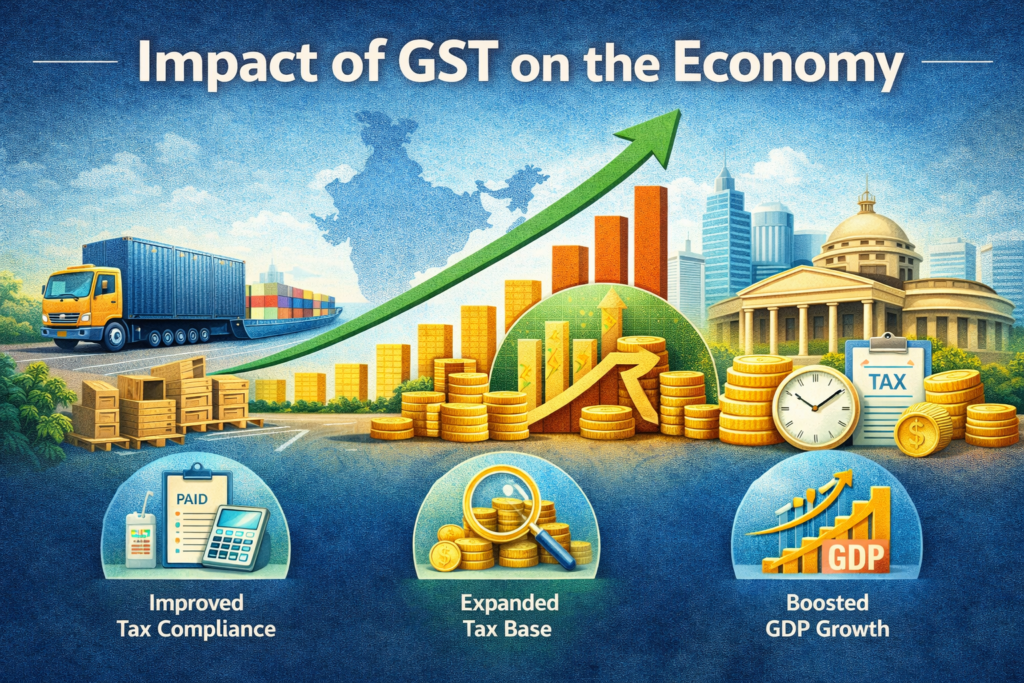
The Goods and Services Tax or GST has had a big impact on Indias economy.
Positive Impacts
- Improved tax compliance has been one of the benefits of GST.
- GST has helped bring businesses into the tax net, which means a wider tax base for India.
- The new tax system has reduced logistics costs for companies making it easier for them to transport goods across the country.
- By encouraging businesses to operate formally GST has helped boost the formal economy in India.
Long-Term Impact
Economists think that GST will help Indias economy grow faster and also make tax collection more efficient, over time. They believe GST will increase Indias GDP growth.
GST will also increase tax efficiency.
GST Example for Consumers
Let us say you want to buy a smartphone that costs ₹20,000.
- The price of the smartphone is ₹20,000.
- If the GST rate is 18 percent
- you have to pay money for the smartphone.
- The GST, on the smartphone is ₹3,600.
- So the final price of the smartphone is ₹23,600.
This GST money goes to the government and the state government when you buy the smartphone depending on what kind of transaction it is.
Future of GST in India
The GST system continues evolving through policy updates by the GST Council.
Possible future developments include:
- Simplifying tax slabs
- Expanding GST coverage
- Improving compliance tools
- Bringing petroleum products under GST
These reforms could further strengthen India’s tax structure.
Frequently Asked Questions (FAQ)
What is GST in simple words?
GST is a single indirect tax on goods and services that replaced multiple taxes in India.
When was GST implemented in India?
GST was introduced on 1 July 2017.
Who collects GST?
Both the central government and state governments collect GST depending on the transaction type.
What is the GST rate in India?
GST rates range from 0% to 28%, depending on the product or service.
Is GST good for the Indian economy?
Most economists believe GST improves tax transparency, compliance, and economic efficiency.
Conclusion
The Goods and Services Tax (GST) is a transformative reform that modernized India’s indirect taxation system. By replacing multiple taxes with a unified structure, GST simplified compliance, reduced cascading taxes, and strengthened the country’s digital tax infrastructure.
While challenges remain, the ongoing improvements by the GST Council continue to refine the system. For businesses, entrepreneurs, and consumers alike, understanding how GST works in India is essential for navigating the modern economic landscape.
Conversion-Focused CTA
If you found this guide helpful and want more expert explainers on Indian taxation, technology, and business, follow trusted digital journalism platforms and stay informed. Bookmark this guide, share it with students or entrepreneurs, and explore more educational explainers to stay ahead in India’s evolving economy.