
Overview and Definition
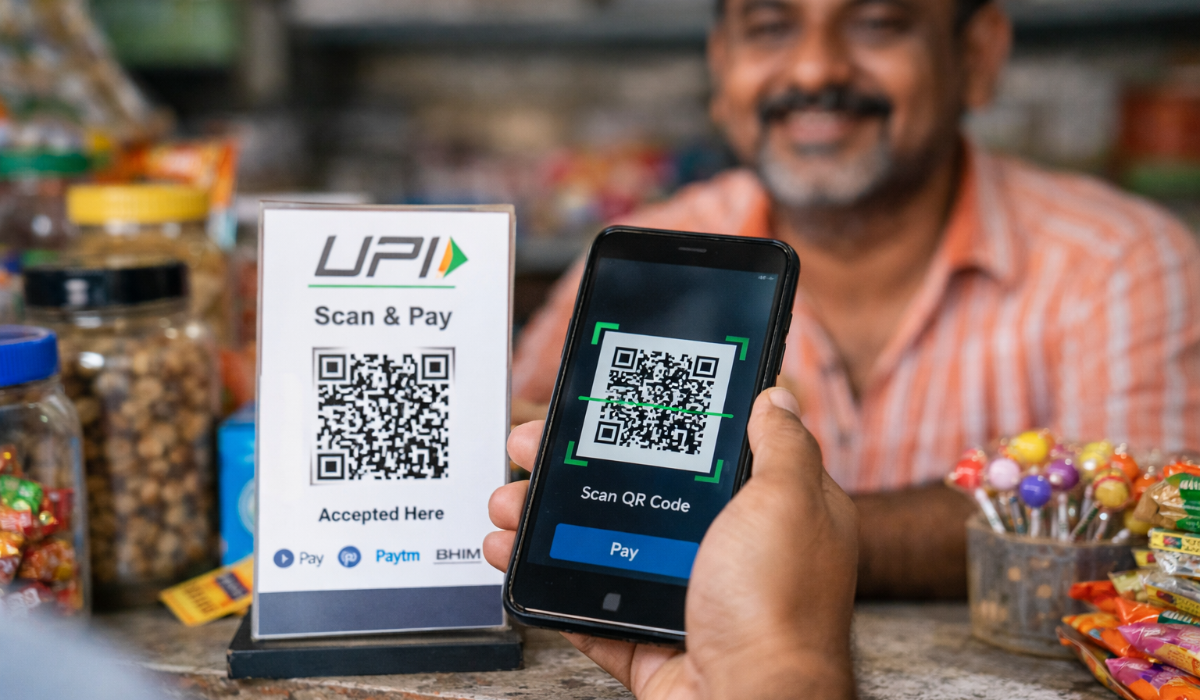
What is UPI? – The Unified Payments Interface (UPI) is the instant and real-time interbank payment system of India, which allows users to transfer funds directly from one bank account to another using mobile devices. Launched in 2016 by the National Payments Corporation of India (NPCI), the RBI-regulated Unified Payments Interface allows users to send and receive payments in real-time using the simple medium of a Virtual Payment Address (VPA) or QR Code, 24 hours a day and 7 days a week. This mobile-based protocol eliminates the complexity of Net Banking, as users do not require account numbers and IFSC codes for daily transactions. Rather, the authenticated transaction is done using the Pin Code of the User.
In short, the meaning of the term ‘UPI Full Form – Unified Payments Interface’ is the unified platform of the Indian payments system, which connects various entities like banks, apps, and merchants. This protocol has marked the beginning of the Digital Payment India era, in which users can make electronic payments as simply as sending messages. This instant and accessible protocol of Unified Payments Interface has marked the beginning of the ‘Cashless India’ initiative, which has significantly reduced the use of physical currencies in the country.
History and Milestones
The journey of UPI is tied to India’s digital payments evolution. Early steps included building a digital identity layer (Aadhaar) and modern payment rails. Key milestones include:
- Pre-2016 – Digital Foundations: The expansion of mobile phone use in the country, along with efforts to integrate the country’s payment systems, created the preconditions.
- April 2016 – Launch: The National Payments Corporation of India announced the launch of UPI. The first applications went live, allowing users to send instant interbank transfers using UPI IDs.
- 2016 (Demonetization): The November 2016 cash ban accelerated interest in digital payments. UPI usage surged as cash shortages drove consumers and small merchants to try mobile payments.
- 2017–2019 – Adoption Spikes: The government launched the BHIM app to promote UPI; major fintech apps (Google Pay, PhonePe) integrated UPI. Adoption grew as banks joined the network and merchants accepted QR codes.
- 2020 – Pandemic Surge: COVID-19 lockdowns boosted contactless, remote payments. UPI volumes doubled as users preferred digital transactions over cash.
- 2023–2025 – Global Recognition: By late 2025, UPI was recognized by the IMF as the world’s largest real-time payment system by volume. Policy schemes like PIDF (incentives for deploying QR infrastructure) and merchant cashback programs drove deep adoption. As of FY 2024–25, over 6.5 crore merchants had UPI QR codes (56.86 crore QR codes deployed).
- 2025 – Record Transactions: Monthly transaction counts crossed 20 billion by late 2025, illustrating UPI’s central role in India’s payments.
These events show how How UPI changed digital payments in India: from a novel platform to an indispensable national utility within a few years
Core Technology and Mechanisms
The UPI payment system explained consists of the following components:
- Virtual Payment Address (VPA): This is a user-friendly identifier, such as alice@bank, replacing the need for bank details.
- Immediate Payment Service (IMPS): This is the backbone of the UPI payment system, providing instant settlement of funds between banks.
- Mobile Apps/UPI Apps: Third-party apps, such as BHIM, Google Pay, Paytm, and other banking apps, use the NPCI APIs to integrate with the UPI payment system, providing user interface functionality for the payment systems.
- Two-Factor Authentication: The UPI payment system is authenticated using a UPI PIN, ensuring that even though funds are settled instantly, the payment is authenticated.
These features ensure smooth transfer, which takes only a matter of seconds, with funds being transferred directly from Payer Bank to Payee Bank without any manual intervention. This real-time rail, therefore, makes UPI different from traditional payment systems like ACH or NEFT, which operate on a batch settlement model. Its inter-operability ensures that any bank account can transact with any other bank account. The system, by design, is open to innovation, with new features being added through third-party apps to make it more user-friendly. So, how UPI works in India is a simple process, where a user selects a payee using the UPI ID or scans a QR code, enters the amount and UPI PIN, and the transaction is done.
Major Applications Across Sectors
UPI India, the national UPI system, covers the entire gamut of the economy:
- Retail and Small Business: Vendors, street hawkers, food establishments, and small businesses accept UPI through QR-based transactions. Democratization of digital acceptance, where a street vendor with a smartphone accepts instant payments. By the beginning of 2025, over 6.5 crore merchants are now on the UPI system.
- E-commerce and Services: Online stores and service providers leverage UPI for transactions, bill payments, and subscription services. For consumers, the “Pay with UPI” option results in instant confirmation.
- Transportation: Auto-rickshaws, taxis, metro, and toll services accept UPI-based transactions, allowing consumers to pay without the need to carry cash.
- Peer-to-Peer Remittance: UPI is particularly useful for splitting bills, sending money between friends and family, and group collections, similar to bank transactions.
- Government and Welfare: Government schemes and programs leverage UPI systems, and the government website accepts taxes and fees through UPI, promoting the transparency and audit trails of funds.

In these examples, the cost, ubiquity, and simplicity of the platform have led to the creation of solutions, ranging from home delivery in metro cities to agri-collections in rural areas, and How UPI is enabling the cashless economy.
Economic Impact and Adoption
The Impact of UPI on the Indian Economy is tremendous, and this is reflected in the exponential growth in the number of transactions and the number of users of the UPI system. This is reflected in the following figures:
- In the financial year 2023-24, the number of transactions through the UPI system crossed over 130 billion transactions, far surpassing the traditional systems.
- As of mid-2024, the number of unique users on the UPI system is 424 million (one-third of the Indian population); the RBI is planning to achieve the milestone of reaching 1 billion unique users by the year 2029
- as part of its financial inclusion strategy. The percentage of the UPI system in terms of the number of transactions is 84.8% of the retail digital transactions in the country as of early 2025, mainly due to the nature of the UPI system, which is mostly used for small transactions.
- The monthly transactions through the UPI system have crossed 20+ billion transactions as of late 2025; for instance, the UPI system handled 21.7 billion transactions amounting to ₹28.33 lakh crore in the month of January 2026, a growth of around 28% over the corresponding period the previous year; the average
These volumes mean that UPI has now become the backbone of the economy, with people selling their produce using UPI, factories using UPI to pay their suppliers, and people buying their daily necessities without the use of cash. This has led to increased transparency in finances, as every transaction is now recorded, and the costs of cash management are reduced. Experts comment that the ease of transactions facilitated by UPI has increased consumption and revenue generated by small businesses. UPI is considered the main pillar of the digital revolution in finance in India
Benefits and Opportunities
The Benefits of UPI helped the system gain immense popularity quickly. Some of the benefits are:
- Instant and Convenient: The payment system is instantaneous, happening within a matter of seconds, at any time of day or night. All a user needs is a smartphone and a PIN.
- Cost Advantage: UPI transactions are zero cost or low cost, which is a big positive factor, especially when the margins are low.
- Interoperability: UPI is an open system, allowing users to send/receive money across any bank, using any UPI-enabled app. This has helped create a level playing field, allowing any player to grow.
- Inclusion: With UPI, anyone who has a bank account, even in a rural village, can send/receive payments. This has helped bring millions of people who did not use traditional banking into the financial system.
- Boost to Small Businesses: Small businesses, including artisans, can use UPI to accept payments digitally, without needing expensive POS machines.
- Integration with New Services: UPI has enabled new services, including services like splitting bills, rounding up, etc.
Overall, Why UPI is popular in India is clear: it addresses everyday payment needs better than previous options. The network effects (more users attract more users) and government support (cashback schemes, merchant incentives) only amplified these benefits.
Risks, Security and Ethical Concerns
Although the system has many advantages, some risks and issues are associated with the development of the UPI system:
- Security Scams: There were phishing attacks and social engineering attacks on the users of the UPI system. However, the system has many security features like two-factor authentication, immediate SMS notifications, and biometric locks for the apps. Also, the RBI has made the use of strong encryption mandatory for the apps. However, users should always be careful and should never reveal their PINs to anyone.
- Transaction Limits: Banks have set daily limits for the transactions made using the UPI system for security purposes. These limits are usually between ₹100,000 and ₹200,000. The users should be aware of the limits in order to avoid disruptions in the service for their needs.
- Digital Divide: Not everyone owns a smartphone or is digitally literate. While promoting digital transactions, it is also important to educate people about the benefits and provide them with the necessary infrastructure, like access to the internet. There is a moral responsibility to ensure that the weaker sections of society are not deprived.
- Privacy: In the digital world, there will be a lot of transactions happening, and the data collected needs to be kept secure and not abused. There is a need to have strict regulations on data privacy.
All these issues are taken care of with active governance, as will be explained in the next section. Is UPI safe for online payments? – Yes, it is, if used properly, and the user has to follow the security guidelines and the government has to enforce them.
Governance, Regulation and Implementation
UPI functions under a collaborative mode of governance. While the NPCI is responsible for the creation and maintenance of the payment system, considering its position as the central payments body in the country, the Reserve Bank of India (RBI) is responsible for the regulatory oversight, including the formulation of rules for banks as well as other FinTech players. Some of the key areas under the governance of the UPI system include:
- Regulatory Framework: RBI formulates the rules for the use of the UPI system, the security measures, etc. Banks have to ensure that they comply with the norms related to KYC.
NPCI Guidelines: NPCI periodically issues circulars for the use of the UPI system, including the specifications for the use of QR codes, tokenization of cards, etc. It also ensures that fraud monitoring is implemented across the member apps. - Implementation: For users, as well as businesses, the implementation requires very little, namely, a bank account, mobile number, and smartphone with an app that supports UPI. For the government, as well as banks, the promotion of UPI apps in india included financial literacy programs, as well as offering cashback for first-time users.
- Interoperability Mandate: The inter-operability of the system is also mandated. This means that any bank or app that wishes to participate must route payments through the system, ensuring that closed systems cannot exist.
- International Expansion: For the expansion of the system into other countries, the NPCI established an organization called NPCI International Payments Limited, which works with other foreign regulators and banks, allowing the system to function outside the country. For instance, the system is now linked to Nepal, Bhutan, and Singapore.
With this collaborative mechanism of governing, India is able to ensure the robustness and reach of UPI. Banks and fintech companies need to ensure the security of the system (two-factor authentication, tokenization, etc.) as per the guidelines set. The regulating bodies also look at the usage patterns to address any ethical issues or abuses of the system that may arise.
Case Studies
- Street Vendor Digitization: The street food market in Jaipur witnessed a high of 80% transactions through UPI QR codes in the year 2023. The vendors claimed that the usage of UPI helped reduce the cash handling burden and also brought in younger age groups, who prefer to pay through UPI.
- Rural Microfinance Payments: The cooperative bank in Uttar Pradesh decided to adopt the UPI platform for the payment of agricultural loans to the rural population. The rural population was able to collect their agricultural loans through the UPI platform, eliminating the need to travel long distances to the bank branches located at remote locations.
- E-commerce Integration: The online grocery store decided to integrate the UPI platform for instant payments. The online store witnessed a growth of 15% in sales, as the consumers appreciated the fact that they did not have to enter their credit card details during the payment process. The online store also offered a promotion for cashback to the consumers using the UPI platform for payment.
Each case illustrates practical benefits of UPI: speed, inclusion, and low cost. Small businesses and consumers alike find UPI aligns with modern commerce needs.
Future Outlook
The Future of UPI in India looks expansive. Policymakers and industry leaders envision a broader ecosystem:
- Continued User Growth: RBI’s financial inclusion strategy includes a target of 1 billion unique UPI users by 2029. To achieve this, the initiative needs to penetrate further into rural areas and, if necessary, leverage community devices.
- Cross-Border Payments: Several countries, which are friendly to us, are either already integrated with UPI or in the process of integrating with it (e.g., Bhutan, Singapore). Initiatives like integrating UPI with Singapore’s PayNow and other similar initiatives will allow international transactions to become as seamless as local transactions.
- Value-Added Services: In addition to person-to-person transactions, UPI has the potential to support other services, such as small-ticket credit, micro-savings, and programmable payments (e.g., integration with smart contracts or UPI on wearable devices).
- Integration with Digital Currency: If the Indian government decides to launch a Central Bank Digital Currency (CBDC), it could also be integrated with UPI, enabling the user to convert between cash, UPI, and digital currency effortlessly.
- Global Benchmark: Industry reports indicate that UPI is likely to become a benchmark for instant payment systems globally. Other nations are emulating the Indian model to completely revamp their systems.
- Technology Upgrades: The technology behind the system is likely to continue to upgrade (faster transactions, AI-based fraud detection systems, etc.). The NPCI and technology partners will ensure that UPI remains at the forefront of technology in the payment systems space.
In realistic scenarios, UPI will remain central to India’s payment landscape in the short, medium, and long term, driving both incremental improvements (like more features in apps) and radical expansions (like 1B users or global adoption). The strong momentum suggests that How UPI works in India could soon be mirrored by similar systems worldwide.
[Source: Ministry of Finance, 2025]
[Source: National Payments Corporation of India, 2026]
[Source: Reserve Bank of India, 2025]
See Also- What Is Geopolitics?
See Also- Artificial Intelligence: History, Types & Global Impact


Pingback: What is BHIM UPI App and How Does It Work?