A subfield of artificial intelligence enabling computers to learn and adapt from experience without being explicitly programmed. Machine Learning is a part of computer science and artificial intelligence that deals with creating systems that can learn on their own from data and get better over time. Without being given instructions for every situation. Of following a strict set of rules that someone made a Machine Learning system creates a model from examples it was trained on and uses that model to make predictions or decisions about new data it has not seen before. Since it was first introduced in the 1950s Machine Learning has become really important and is now a big part of computer science that affects our daily lives. It is used in the search engines we use every day the suggestions we get for things we might like the systems that protect our bank accounts from fraud and the tools that doctors use to diagnose patients in hospitals around the world. The field of Machine Learning combines statistics, linear algebra, probability theory and software engineering.. With all the free online resources and libraries available it is easier, than ever for people to get started with Machine Learning.
What is Machine Learning in Simple Words
Imagine you want to teach a kid to know what cats are. You do not give them a book with rules that says if an animal has four legs and whiskers and pointed ears then it is a cat. Instead you show them a lot of pictures of cats and dogs and birds. Let them figure it out by themselves. Machine learning is the thing but instead of a kid it is a computer program and the pictures are information that the computer program uses to learn about cats.
So when we talk about machine learning we are really talking about machine learning. Machine learning is when a computer uses a set of rules to look at a lot of information and then it uses that information to make a plan. This plan is like a set of instructions that helps the computer do things like things into groups make guesses about what might happen or create new things.. The more the computer uses this plan the better it gets at doing these things.
There are some ideas to know about machine learning from the beginning.
- Training data is what the computer learns from.
- Features are the things we can measure about the examples the computer is learning from like how bright a picture’s how old someone is or how much something costs.
- Labels are the answers that we give to the computer when we are teaching it.
- The model is like a formula that the computer uses to figure out what to do with the information it gets.
- Inference is when the computer uses the plan it learned to make guesses, about information. This is all part of machine learning.
History & Background
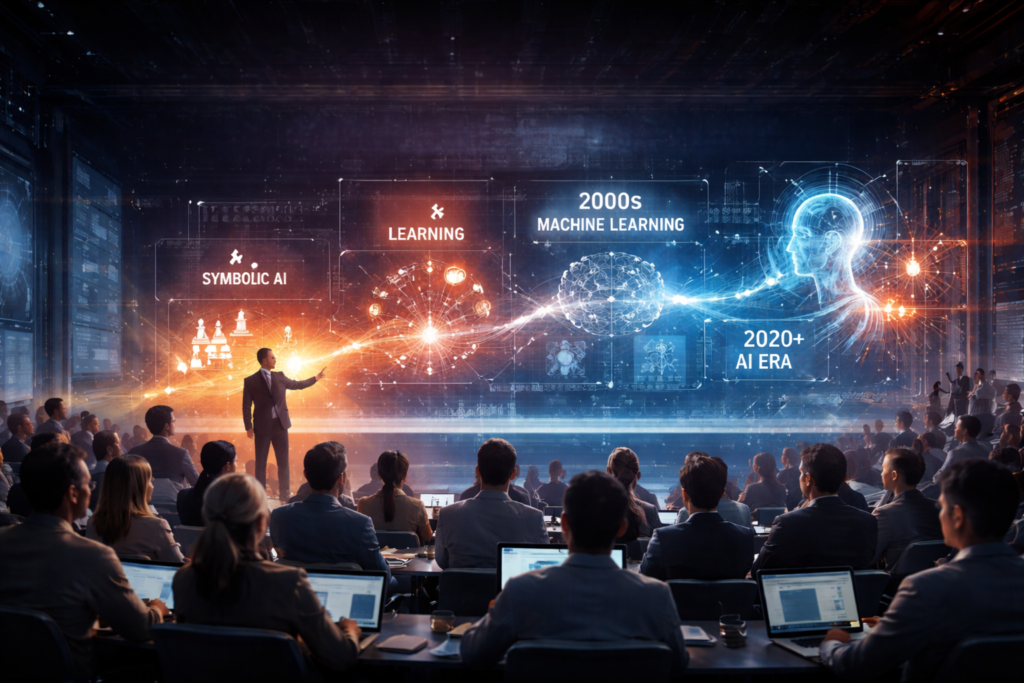
The idea of machine learning started with a question: Can machines think? This question was asked by Alan Turing in 1950. It was the beginning of the field of Artificial Intelligence.
The term machine learning was first used by Arthur Samuel in 1959. At that time he was working at IBM. He was developing a program that could play checkers. The program could improve its play by studying itself.
Here are some important events, in the development of machine learning:
- 1957: Frank Rosenblatt created the Perceptron. This was the neural network.
- 1967: A simple way to recognize patterns was developed. It was called the k- neighbor algorithm.
- 1980s: The backpropagation algorithm was discovered. This helped neural network research.
- 1997: IBMs Deep Blue beat a world chess champion. The champion was Garry Kasparov.
- 2006: Geoffrey Hinton made a breakthrough. He worked on deep belief networks. This started the deep learning era.
- 2012: A computer program called AlexNet won a contest. It was called ImageNet. It made a 26% improvement. This was the start of the deep learning revolution.
- 2016: AlphaGo beat a Go world champion. The champion was Lee Sedol.
- 2023-2026: Large Language Models are changing industries.
Types of Machine Learning
Broadly speaking, machine learning has four main paradigms, each characterized by the training signal used by the learning algorithm. It is very important that one understands the different types of machine learning before deciding which is best for a given situation.
Supervised Learning
In supervised learning, the model is given a set of examples with their correct answers. It then learns to map examples to their answers and generalizes to new examples. This is by far the most popular and commercially successful type of learning.
Examples: spam detection in emails, house price prediction, image classification, credit scoring.
Unsupervised Learning
In unsupervised learning, there is no correct answer to learn. The model must find hidden patterns and structure on its own. This type of learning is very powerful for exploratory data analysis when you do not know what to look for.
Examples: customer segmentation, anomaly detection, topic modeling, gene expression analysis.
Reinforcement Learning
In reinforcement learning, an agent learns to behave in an environment by performing actions and receiving numerical rewards. Over time, the agent learns to behave in a way that maximizes reward. Reinforcement learning has been used for some of the most impressive AI breakthroughs of the last decade.
Examples: game-playing AIs (chess, Go, video games), robotics, self-driving cars, trading algorithms.
Semi-Supervised Learning
A mix of supervised and unsupervised learning. This type of learning is very useful in real-world situations where labeling examples is expensive and time-consuming.
Supervised vs Unsupervised Learning
The difference between learning and unsupervised learning is really important for someone who works with these things to understand. Supervised learning and unsupervised learning are two types of learning that’re very different.
Here is a side-, by-side comparison
of learning and unsupervised learning to help make it clearer.
| Dimension | Supervised Learning | Unsupervised Learning |
| Data Required | Labeled (input + correct output) | Unlabeled (input only) |
| Goal | Predict an output for new inputs | Discover hidden structure in data |
| Human Effort | High (labeling is costly) | Low (no labeling needed) |
| Common Tasks | Classification, Regression | Clustering, Dimensionality Reduction |
| Evaluation | Straightforward (compare to labels) | Subjective / domain-dependent |
| Examples | Spam filter, fraud detection | Customer segmentation, anomaly detection |
In practice, most large-scale commercial systems combine both approaches. A recommendation system, for example, can use supervised learning for click probability estimation and unsupervised learning for user clustering.
Machine Learning Algorithms
Machine learning algorithms are like recipes that help a system learn from data. Here are the popular types of machine learning algorithms:
Linear and Logistic Regression
These are the basics of learning. Linear regression tries to guess a number, like the price of a house. Logistic regression tries to figure out if something is one thing or another like if an email’s spam or not.
Decision Trees and Random Forests
Decision trees are like a list of yes or no questions that help figure out what something is. Random forests are like a bunch of decision trees all working together. They help make sure the answer is not too specific to the data they learned from. These are some of the reliable and easy to understand algorithms.
Support Vector Machines
Support Vector Machines find the way to separate two groups of things. They are really good at things like classifying text and understanding biology.
K-Nearest Neighbors
K-Nearest Neighbors is an algorithm that looks at what is around a new piece of data to figure out what group it belongs to. It is easy to understand. Can be slow when there is a lot of data.
Neural Networks and Deep Learning
Neural networks are like a copy of the brain. They have layers of connected parts that help them learn. Deep neural networks have hidden layers and are really good at things like recognizing pictures, understanding language and creating new things. Machine learning algorithms like these are very useful, for tasks. Machine learning algorithms are used every day to help with jobs.
# Conceptual structure of a neural network layer output = activation_function( weights · input + bias ) # Common activation functions: # ReLU: f(x) = max(0, x) # Sigmoid: f(x) = 1 / (1 + e^-x) # Softmax: f(x_i) = e^x_i / Σ e^x_j [for multi-class output]
Gradient Boosting (XGBoost, LightGBM)
A technique where multiple models are learned one after another to compensate for the mistakes made by the previously learned models. This algorithm has consistently been a winner in data competition events (e.g., Kaggle). This algorithm is also the preferred choice for dealing with tabular data in industry settings.
Clustering Algorithms (K-Means, DBSCAN)
Unsupervised learning algorithms that cluster data points based on their similarity.K-Means clustering divides the data points into k spherical clusters. DBSCAN clustering also identifies noise/outliers, especially useful for fraud detection.
Machine Learning Models
A machine learning model is the result of training a machine learning algorithm on a set of data, which represents everything that the machine learning system has learned, all the weights, thresholds, and parameters, and this is the actual model that gets deployed in production for making predictions.
Models are broadly categorized based on the architecture used in the model and the type of problems they solve:
| Model Type | Best For | Popular Examples |
| Regression Models | Predicting continuous values | Linear Regression, Ridge, Lasso |
| Classification Models | Assigning categories | Logistic Reg., SVM, Random Forest |
| Clustering Models | Grouping similar data | K-Means, DBSCAN, Gaussian Mixture |
| Generative Models | Creating new content | GANs, VAEs, LLMs, Diffusion Models |
| Sequence Models | Time-series & language | LSTM, GRU, Transformer |
Modern cloud platforms (AWS SageMaker, Google Vertex AI, Azure ML) allow teams to train, version, and serve machine learning models at scale with minimal infrastructure effort.
Machine Learning Techniques
When it comes to machine learning the choice of algorithm is not the thing that matters. Machine learning practitioners use different machine learning techniques to make their models more accurate to make them work better with new data and to make them more efficient.
Feature Engineering
This is the process of making new and useful input variables from the data that we have. It is often the important thing we can do to make our machine learning project better. If we have features a simple algorithm can actually work better than a complex one.
Cross-Validation
This is a way to test how well a model will work with data that it has not seen before. We do this by splitting the data we have into groups and then we use some of the groups to train the model and the rest to test it. We do this times and it helps us get a good idea of how well the model will work with new data.
Regularization
There are things we can do to prevent our models from getting too good at fitting the data we have but not good at working with data. This is called overfitting. We can use things like L1 and L2 regularization to add a penalty to the model if it gets too complicated.
Transfer Learning
of starting from scratch and training a whole new model we can use a model that has already been trained on a lot of data. We can then use this model and fine-tune it to work with the amount of data that we have. This makes it much faster. We need less data.
Hyperparameter Tuning
Before we train a machine learning algorithm we need to set some things like how fast it learns or how deep it looks. We can try different settings to find the best ones. We can use things, like grid search, random search and Bayesian optimization to find the settings.
Ensemble Methods
We can also combine models to make one that works even better. We can do this by bagging, boosting or stacking. This is why the people who win competitions usually use ensembles. Machine learning models work better when we combine them. Machine learning practitioners use methods to make their machine learning models work better.
The Machine Learning Process
The machine learning process is like a cycle that we have to follow step by step. If we understand what happens in each step we can avoid making mistakes that will cost us a lot of time and money. We want to make sure our system works well and does what it is supposed to do. Here is what we have to do from start to finish:
1.Problem Definition
We need to say what we want to achieve with our machine learning project. Is it a problem where we have to put things into categories or is it a problem where we have to predict a number? What will tell us if we are successful. Is it how accurate our model is or is it something like how much money we make? If we do not define the problem correctly it will be very expensive to fix
2.Data Collection & Sourcing
We have to get data from places like databases, websites or sensors. The data can be. Not organized. The quality and quantity of the data will determine how good our machine learning model is.
3.Exploratory Data Analysis (EDA)
We have to look at the data and see what it looks like. We need to find any errors or things that do not make sense and see how different pieces of data are related to each other. If we do this we can avoid problems on.
4.Data Preprocessing & Feature Engineering
We have to fix any missing data and make sure the data is in a format that our machine learning model can use. This step takes up a lot of time. About 70 to 80 percent of the time we spend on the project.
5.Model Selection & Training
We have to choose the algorithm for our machine learning project and then use it to train our model. We have to split our data into sets so we can test our model and make sure it works well.
6.Model Evaluation
We have to see how well our model works by testing it with data it has not seen before. We have to use the metrics to measure how well it does. Like accuracy or precision. We also have to make sure our model is fair and works well in situations.
7.Deployment & Monitoring
We have to make our model available to others either through a website or an application. We have to watch it to make sure it keeps working and fix it if it starts to make mistakes. We also have to update it so it can keep up with changes, in the world and keep working well. The machine learning process is something we have to keep working on to make sure our model stays good.
Explore more insights on AI, innovation, and future technologies in our Technology category.
Applications of Machine Learning
The applications of machine learning are really changing every industry and field of study. The following areas have seen the changes:
Healthcare & Medicine
Machine learning models are helping doctors look at X-rays and MRI scans to find tumors and they are just as good as human doctors at doing this. These models can also tell which patients are likely to get sick or get worse so doctors can help them before it happens. Machine learning is also used to find medicines by looking at billions of possibilities.
Finance & Banking
Systems that detect fraud can look at thousands of things about a transaction in time to see if something is wrong. Models that decide who can get a loan are also using machine learning. Some computer programs can even. Sell stocks really fast, in a matter of seconds.
Natural Language Processing (NLP)
Machine learning is used in lots of ways with language from fixing spelling mistakes to understanding what people are saying. Search engines, chatbots, translation services and programs that summarize documents all use machine learning to understand language.
Computer Vision
Machine learning is used to help computers see and understand things like recognizing faces, driving cars checking the quality of things in factories and looking at pictures from space to see how well crops are doing. It is also used in security systems to detect things that are happening now.
Recommendation Systems
Websites like Netflix, Spotify, Amazon and YouTube use machine learning to suggest things to people based on what they like. This is really important for these companies. It helps them make a lot of money. In fact Amazon says that machine learning helps them make about 35% of their money and Netflix says that people watch things they suggest 80% of the time.
Manufacturing & Industry 4.0
Machine learning models can look at data from machines in factories to see when they might break, which helps prevent problems and saves time. Machine learning is also used to check the quality of things, in factories, which’s faster and better than people can do.
Machine Learning Examples in Real Life
You use machine learning in life many times a day. Often without even noticing it:
- Google Search uses PageRank and machine learning signals to order search results
- Face ID and Face Unlock use a machine learning model to map your face from an infrared scan
- Amazons “Customers also bought” feature uses machine learning to find patterns in what millions of users buy
- Spotifys Discover Weekly playlist uses machine learning to create a unique playlist just for you
- Credit Card companies use machine learning to detect transactions that do not match your spending history
- GPS and Waze use machine learning to find the best route based on traffic data
- Gmails Smart Compose feature uses a machine learning model to predict what you will write next
- Apple Watch uses machine learning to detect atrial fibrillation from heart rhythm data
- Social media sites use machine learning to decide which posts to show you first
- Machine learning is also used to translate text, between many different languages in real time
Machine Learning vs Artificial Intelligence — What’s the Difference?
The machine learning vs artificial intelligence difference is a common point of confusion. The simplest way to understand their relationship is through concentric circles:
Nested RelationshipArtificial Intelligence ⊃ Machine Learning ⊃ Deep Learning
AI is the broad science of making machines intelligent. ML is a subset of AI that uses data-driven learning. Deep Learning is a subset of ML using multi-layer neural networks.
| Aspect | Artificial Intelligence (AI) | Machine Learning (ML) |
| Scope | Broad — any technique that makes machines smart | Specific — statistical learning from data |
| Rules | Can be rule-based or data-driven | Always data-driven |
| Examples | Chess engines, expert systems, robotics | Spam filters, recommendation engines, fraud detection |
| Requires data? | Not necessarily | Yes — always |
| Self-improvement | Not inherently | Yes — models improve with more data |
The confusion is understandable: in popular culture, “AI” often specifically refers to ML. But a traditional chess program using hard-coded if/else logic is AI but not ML. And a spam filter using labeled data is both.
Machine Learning for Beginners — Step by Step
If you are new to machine learning this step-by-step guide will help you learn efficiently:
Step 1: Build Your Mathematical Foundation
To start with machine learning you need to understand some math concepts. You should know about linear algebra, which includes vectors, matrices and dot products. You also need to learn about calculus, specifically derivatives and gradients. Additionally you should study probability and statistics including distributions and Bayes theorem. Khan Academy and 3Blue1Browns “Essence of Linear Algebra” series are resources to begin with.
Step 2: Learn Python
Python is the programming language used for machine learning. First focus on learning core Python.
Master the scientific stack, which includes:
- NumPy for numerical computing
- pandas for data manipulation
- Matplotlib and Seaborn for visualization
You can learn Python from “Automate the Boring Stuff with Python” a beginner-friendly resource.
Step 3: Take a Structured Course
There are free machine learning courses online.
Here are some top recommendations:
- Andrew Ngs Machine Learning Specialization on Coursera. A popular ML course
- fast.ai Practical Deep Learning. A hands-on approach
- Googles Machine Learning Crash Course. A concise and practical course
- Kaggle Learn. An online course with interactive notebooks
Step 4: Build Projects
Just learning theory is not enough.
You need to work on projects to build your skills.
Start with beginner projects like:
- Predicting survival in the dataset
- Predicting house prices
- Recognizing digits (MNIST)
- Analyzing sentiment in movie reviews
Each project helps you build intuition that you can’t get from lectures
Step 5: Compete on Kaggle
Kaggle competitions are a way to practice machine learning.
Even if you just read the discussion forums and study solutions you’ll learn a lot.
Start with the “Getting Started” competitions.
Step 6: Specialize
Machine learning is a field.
Once you have a foundation choose a domain to specialize in such as:
- Computer vision
- Natural Language Processing (NLP)
- Time-series forecasting
- Reinforcement learning
- MLOps
Deep specialization is more valuable for your career, than shallow breadth. Machine learning is an area to focus on. You should learn machine learning step by step. Start with machine learning basics. Then move on to advanced topics. Practice machine learning with projects and competitions.
Frequently Asked Questions (FAQ)
What is machine learning in words?
Machine learning is a way of teaching computers to learn from examples and experience. This is different from following a set of rules. Like a person learns to recognize patterns when they see them a machine learning algorithm finds patterns in data. Then it uses those patterns to make predictions when it gets new information.
What are the main types of machine learning?
There are four types of machine learning.
- Supervised Learning. This is when the computer learns from examples that are labeled.
- Unsupervised Learning. This is when the computer finds patterns in data that is not labeled.
- Reinforcement Learning. This is when the computer learns by trying things and seeing what works.
- Semi-Supervised Learning. This is a mix of labeled and unlabeled data.
What is the difference between machine learning and artificial intelligence?
Artificial Intelligence is a field that is all about making machines smart. Machine learning is a part of Artificial Intelligence that helps machines get smart by learning from data. So all machine learning is Artificial Intelligence. Not all Artificial Intelligence is machine learning.
What are some machine learning applications in life?
You use machine learning all the time. For example when your email filters out spam or when your phone autocorrects your text that is machine learning. Netflix uses machine learning to recommend movies. Google Maps uses it to figure out the best route. Siri and Alexa use machine learning to understand what you are saying.
Is there a good machine learning course that’s free online?
Yes there are great options. You can take Andrew Ngs Machine Learning Specialization on Coursera for free. Google also has a free Machine Learning Crash Course. Kaggle Learn and fast.ai are also highly recommended. If you want to learn from a university MIT has a course called Introduction to Machine Learning.
How long does it take to learn machine learning?
If you study machine learning for 10 to 15 hours a week you can learn the basics in 3 to 6 months. To become really good at machine learning it usually takes 12 to 18 months of study. Working on projects. If you already know Python and math you can learn machine learning
Do I need a degree to work in machine learning?
No you do not need a degree to work in machine learning. Many people who work in machine learning have degrees. Many others have taught themselves or gone to bootcamps. What is most important is that you can show you have skills. This means having a GitHub profile with projects you have worked on doing well in Kaggle competitions and having models that you have deployed.
What programming language is used in machine learning?
Python is the popular language used in machine learning. This is because Python has libraries, like scikit-learn, TensorFlow and PyTorch that make it easy to do machine learning. R is also used, in academia. Julia is a language that is being used more and more for machine learning. For production systems C++ and Java are used because they are fast and reliable.