US-India Trade Deal 2026: Big Opportunity for Indian Economy
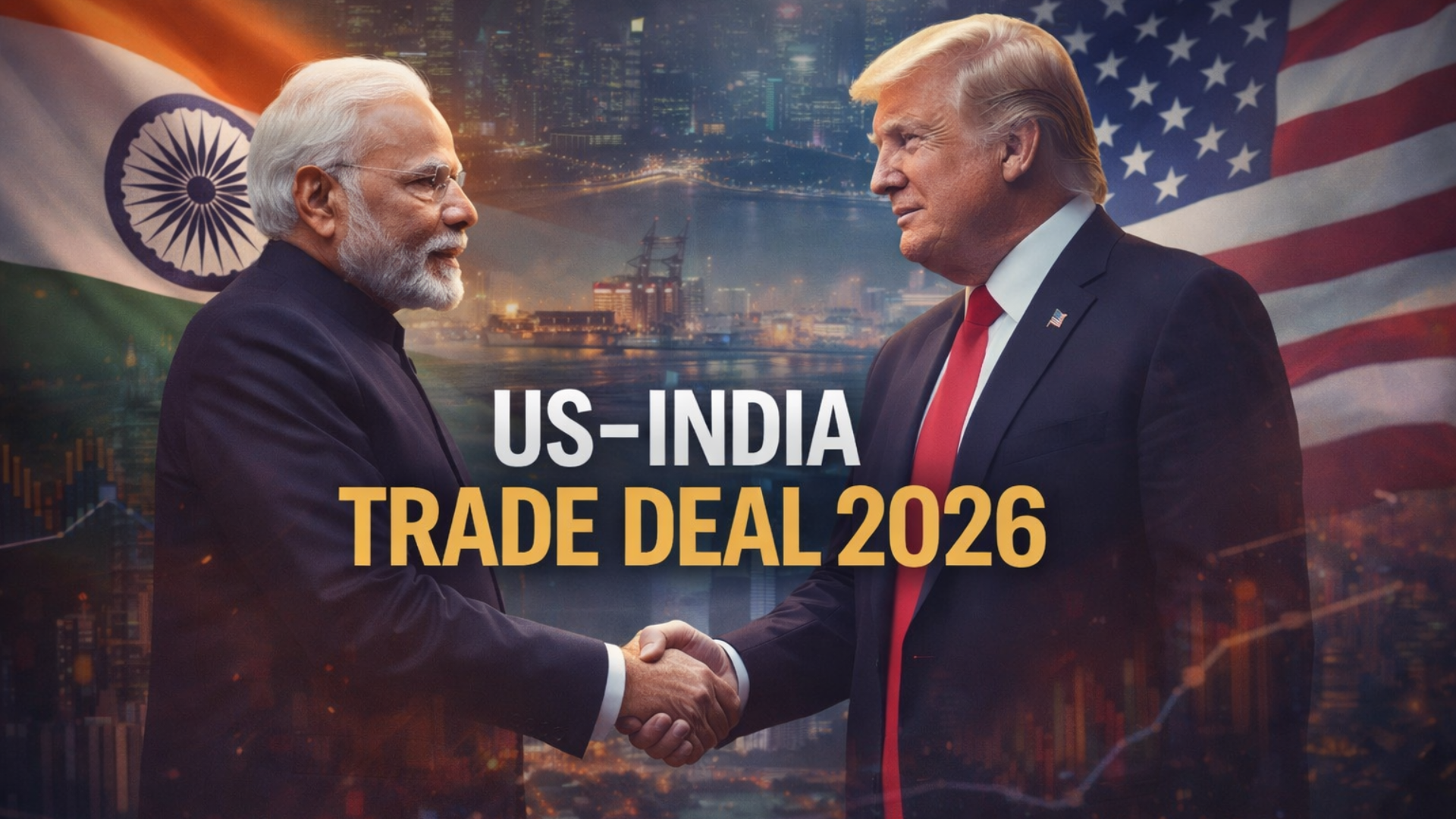
US-India Trade Deal 2026: In a historic move which is set to change the course of global trade, US President Donald Trump and Indian Prime Minister Narendra Modi have finalized the framework for the historic US-India Interim Trade Agreement, which was unveiled on February 2, 2026. This US India trade deal latest news is set to usher in a new era in the relationship between the two nations, opening up massive business opportunities between the US and India.
This is the US India trade deal explained in simple terms for every Indian interested in knowing the future of our economy.
What Is the US-India Trade Deal 2026? — Explained Simply
The US India trade deal 2026 is a two-phase trade agreement: Interim Agreement + Bilateral Trade Agreement (BTA). It has been initiated by the partnership between Trump and Modi. The framework of the Interim Agreement has been officially published through a White House Joint Statement on February 6, 2026.
At its core, this India US trade agreement latest news involves:
- US tariffs on Indian goods slashed from ~50% to 18% — an immediate economic relief for Indian exporters
- India eliminating or reducing tariffs on all US industrial goods and a wide range of US agricultural products
- India committing to purchase over $500 billion of US products — energy, technology, aircraft, coal, and precious metals — over five years
- Removal of India’s punitive 25% tariff surcharge linked to Russian oil purchases, effective February 7, 2026
This India US strategic deal news is one of the most significant bilateral trade agreement milestones between the world’s two largest democracies.
US-India Trade Deal Impact on Indian Economy: Key Numbers
Goldman Sachs Research projects India’s real GDP growth at 6.9% in 2026, with the US India trade deal acting as a meaningful tailwind. The deal removes what businesses had described as a persistent “tariff overhang” that had weighed on Indian equities and export sentiment through 2025.
Key economic indicators post-deal:
| 📊 Parameter | 🔴 Before Deal | 🟢 After Deal |
|---|---|---|
| US Tariff on Indian Goods | ~50% | 18% |
| India’s GDP Growth Forecast (2026) | 6.6% (est.) | 6.9% (Goldman Sachs) |
| Indian Equity Market Sentiment | Negative (2025) | Recovering |
| Indian Exports to US (2024 base) | ~$87 billion | Upward trajectory |
This US India trade deal impact on Indian economy is being felt across sectors — from Dalal Street to factory floors in Surat and Tiruppur.
How India Benefits from the US Trade Deal

Understanding the benefits of US India trade agreement requires a sector-specific lens. Here is where Indian businesses and workers stand to gain most:
Textiles, Leather & Apparel — Labour-Intensive Sectors Get a Lifeline
India’s garment and leather exporters faced brutal competition at 50% tariffs. With rates now at 18%, Indian products regain price competitiveness against rivals like Bangladesh (20%), Vietnam (20%), and Pakistan (19%). India manufacturing boost from US deal is most immediately visible here. Millions of jobs in Tiruppur, Surat, and Agra directly benefit.
IT & Technology Sector — Strategic Alignment Unlocks New Growth
The India US tech trade deal is a centrepiece of this agreement. Both nations have committed to significantly increasing bilateral trade in technology products, including GPUs and data centre goods. The US contributes over 60% of India’s IT sector revenues. Reduced geopolitical overhang and better strategic alignment are expected to support fresh discretionary tech spending by US clients. India tech sector US partnership is now on stronger footing than ever.
Pharmaceuticals, Gems & Diamonds — Tariff Relief Confirmed
The White House confirmed that upon full implementation, reciprocal tariffs on Indian generic pharmaceuticals, gems, diamonds, and aircraft parts will be removed. India exports nearly $6 billion worth of chemicals to the US annually — lower tariffs improve pricing competitiveness. India’s pharma sector, already a global leader in generics, gains a structural advantage.
Auto Components & Engineering Goods
Auto ancillary manufacturers supplying to US commercial vehicle segments gain a significant pricing edge. With tariffs reduced from 50% to 18%, India export to USA benefits are most tangible for mid-sized component exporters. Capital goods companies with US exposure also benefit from improved order conversion rates.
Startups & Digital Trade — The Future Frontier
A major policy boost is given to the US-India startups partnership. It is agreed to set up strong digital trade rules between the two countries, removing digital trade barriers and laying out the path for digital investments. This is one of the long-term strategies to achieve the $1 trillion digital economy.
Oil Prices Surge Worldwide: Global Oil Prices Today Hit $107 as Middle East Oil Crisis Deepens
US India Supply Chain Partnership: The China Factor
One of the most strategically significant elements of this India US supply chain partnership is its geopolitical underpinning. Both nations have agreed to strengthen economic security alignment to enhance supply chain resilience — a clear signal that the US-India partnership is being built partly as a counterweight to China.
This supply chain diversification strategy creates enormous export opportunities for India in USA across electronics manufacturing, semiconductors, and critical minerals. As global companies continue to rebalance their supply chains away from China, the Make in India initiative is well-placed to take advantage of the resulting shift in global manufacturing.
The agreement also includes collaboration on export control and investment policies, which indicates the expansion of the US-India Initiative on Critical and Emerging Technology (iCET).
US India Trade Deal Explained: What India Agreed To
While the deal delivers clear benefits, understanding the full picture is essential. How the US India trade deal affects India on the concession side:
- India will eliminate or reduce tariffs on all US industrial goods and a wide range of agricultural products including dried distillers’ grains, tree nuts, fresh fruits, soybean oil, wine, and spirits
- India will address non-tariff barriers on US medical devices and ICT products
- India has committed to curbing Russian oil imports, with the US monitoring compliance
- India will work toward digital trade rules that address discriminatory practices
Commerce Minister Piyush Goyal confirmed the deal will “protect sensitive sectors — the interests of our agriculture and dairy sectors,” though precise details on agricultural market access remain part of ongoing BTA negotiations.
Why the US-India Trade Partnership Is Important
The US India economic partnership carries significance far beyond tariff numbers:
- It repositions India as a preferred global trade partner of the world’s largest economy
- It strengthens India’s global trade position as negotiations with the EU also progress
- It accelerates foreign investment into India — the deal removes the political risk premium that had dampened FDI in 2025
- It supports India’s ambition to become a Viksit Bharat (Developed India) by 2047
India’s Home Minister Amit Shah hailed it as an agreement that will “open new doors of opportunities for every Indian” and provide momentum toward making India a leader in every sector by 2047.
India US Trade Market Growth: What Investors Should Watch
For investors tracking India US trade market growth and India US trade investment opportunities, here are the key sectors and signals:
✅ Auto ancillaries & auto components — tariff-driven pricing advantage
✅ Textiles, leather, and apparel — labour-intensive export sectors
✅ Chemicals and specialty pharma — $6B export base, improved margins
✅ IT & digital services — geopolitical alignment supporting spending
✅ Gems, diamonds & jewellery — tariff removal pending full BTA
✅ Data centres & AI infrastructure — GPU trade and joint tech cooperation
Business growth after US India deal will be gradual — implementation, rules of origin, and regulatory clarity will determine real timelines. But the directional shift in India USA import export business is clearly positive.
US India Trade Deal 2026: The Verdict
The US India trade deal 2026 is an historic, yet evolving, landmark in international trade. It signals a strategic shift in one of the world’s most important relationships, which encompasses economic, geopolitical, and trade chain considerations in one package.
The impact of the India US trade deal to the country can be viewed from multiple angles: export relief, positive sentiment, deepening tech ties, and long-term positioning in the global trade chain. For the Indian economy, which seeks to monitor economic growth in an environment of global uncertainty, the US-India trade deal can be considered a floor and a foundation.
The global trade position of India has never been more robust, and with the full BTA negotiations yet to be concluded, the best of the US-India economic partnership could yet be to come.
Quick Summary Box:
| 📌 Key Term | 📖 Detail |
|---|---|
| Deal Announced | February 2–6, 2026 |
| US Tariff on India | Reduced from ~50% to 18% |
| India’s $500B Commitment | Energy, tech, coal, agri (5-year horizon) |
| India GDP Growth (2026) | 6.9% (Goldman Sachs forecast) |
| Full BTA Status | Negotiations ongoing |
| Next Milestone | Interim Agreement formal signing |
For continuous updates on the US India trade agreement today and India US trade announcement 2026, bookmark this page