Introduction
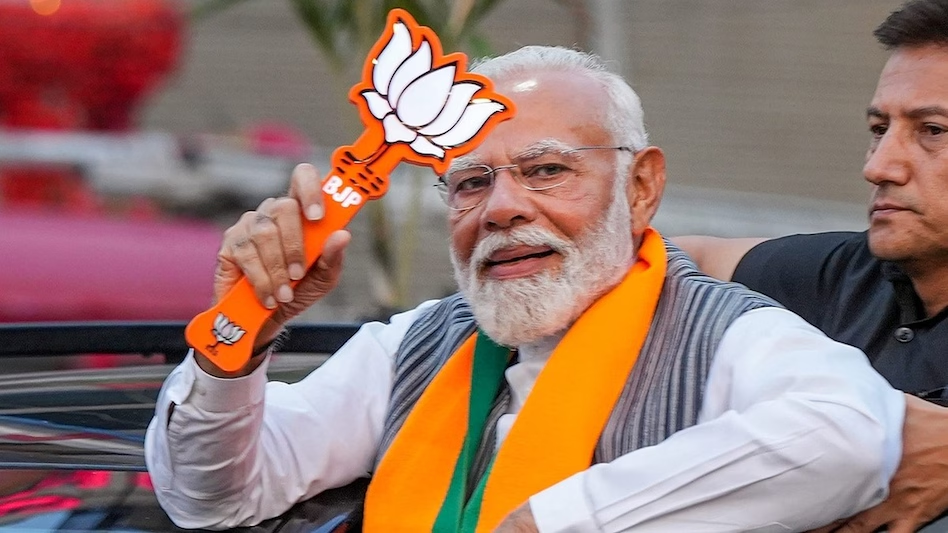
Narendra Modi is a man who has done a lot for India. He is the the 14th Prime Minister of India and people think he is one of the most important leaders in Indias history. His Narendra Modi biography is a compelling story of a man who rose from extraordinarily humble beginnings. He started out helping his father sell tea at a stall in a town in Gujarat. Now he is the powerful person in India.
The Prime Minister of India Narendra Modi has been in office for three terms since 2014. This is a deal because only one other person, Jawaharlal Nehru has done this before. Narendra Modi has been part of the Bharatiya Janata Party and the Rashtriya Swayamsevak Sangh for a time. He has learned to be patient and good at politics. He has also changed himself times to get where he is today.
People have opinions about Narendra Modi. Some think he has done a job of changing how people see India. Others think he has made some mistakes.. Everyone agrees that Narendra Modi is a very important person in Indian politics. This article will tell you about who Narendra Modi’s what he has done and why he is so important to India. It will give you an honest look, at his life and what he has achieved as the Prime Minister of India Narendra Modi.
Quick Facts
- Full Name: Narendra Damodardas Modi
- Date of Birth: 17 September 1950
- Birthplace: Vadnagar, Gujarat, India
- Age (2025): 75 years
- Education: B.A. Political Science (University of Delhi), M.A. Political Science (Gujarat University)
- Political Party: Bharatiya Janata Party (BJP)
- Office: 14th Prime Minister of India (since 26 May 2014)
- Previous Role: Chief Minister of Gujarat (2001–2014)
Narendra Modi Early Life and Education
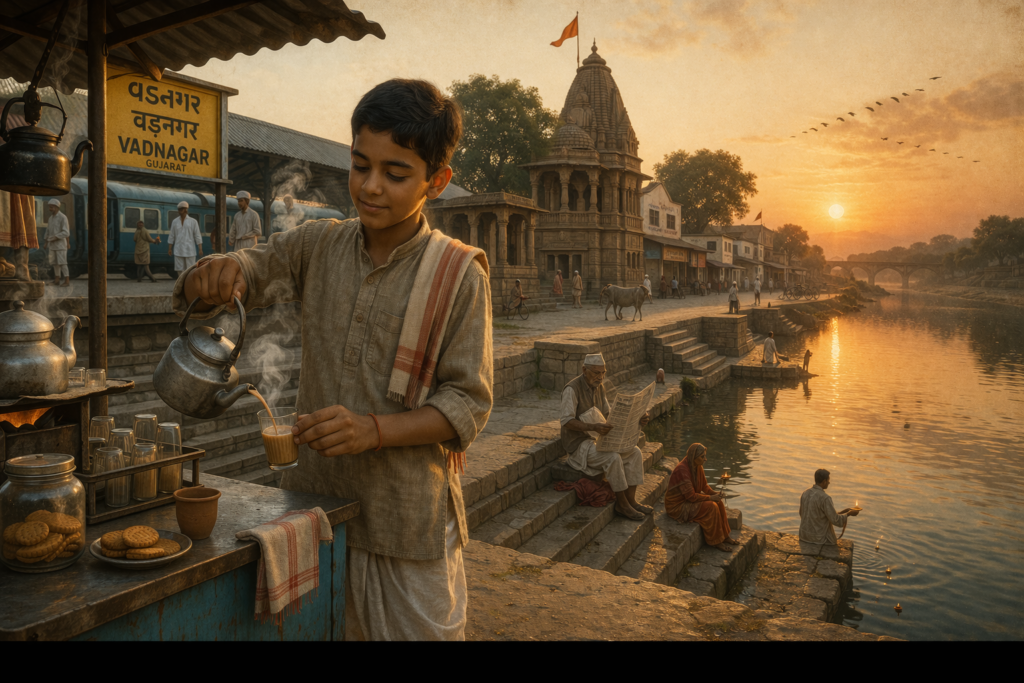
Narendra Modi was born on 17 September 1950 in a town called Vadnagar in what is now the state of Gujarat. His family was not very rich his father Damodardas Mulchand Modi had a grocery and tea business. Narendra Modi was the third of six children his mothers name was Hiraben Modi. The family had to be careful with money so young Narendra Modi helped his father at the tea stall near the railway station. This is a story that people often tell about Narendra Modi.
When Narendra Modi was a child he liked to think about things he liked to exercise and play outside. He joined a group called the Rashtriya Swayamsevak Sangh they had programs for people. This group taught Narendra Modi about Hindu culture and how to help people. After he finished school in Vadnagar Narendra Modi traveled around India. He saw different cultures and places this helped shape who he is today.
In terms of Narendra Modi’s qualification. Narendra Modi went to the University of Delhi. Studied Political Science. He did not go to classes he studied through a special program. Later he got a Master of Arts in Political Science from Gujarat University in Ahmedabad. Many universities have offered Narendra Modi degrees but he has said no. He believes that it is more important to earn a degree than to have one given to him. Narendra Modi studied science and he also worked in politics for a long time. This helped him understand how to govern he used this knowledge when he was the Chief Minister of Gujarat and the Prime Minister of India. Narendra Modis experiences and education have made him the leader he is today Narendra Modi has a foundation, in politics.
Narendra Modi’s Political Journey: From RSS Pracharak to National Leader
Narendra Modis political journey started when he joined the RSS in the 1970s. He became a full-time pracharak for the RSS, which means he was a volunteer who gave up his personal life for the cause of social and ideological work. Narendra Modi was very disciplined. Had great organisational ability and communication skills. These skills made him stand out in the RSS hierarchy. He rose through the ranks of the RSS in an purposeful way.
In 1987 Narendra Modi formally joined the Bharatiya Janata Party (BJP), which is also known as the BJP. One year later he was appointed as the General Secretary of the BJPs Gujarat branch. Narendra Modis ability to organise things proved to be very valuable to the BJP. He played a role in the BJPs big wins in the 1995 Gujarat state assembly elections. These wins resulted in the formation of Indias ever BJP-led state government. This achievement made Narendra Modi known as an election strategist. He earned a lot of respect from the national party leadership.
Narendra Modis national profile grew more in the 1990s. He helped coordinate the BJPs Somnath to Ayodhya rath yatra, which was led by L.K. Advani. Narendra Modi was also very involved in the BJPs preparations for the 1998 and 1999 elections. He showed that he could work on both electoral tasks at the same time. By the time he became the Gujarat Chief Minister in October 2001 Narendra Modi was already an experienced political operator. He had roots in Gujarats political landscape.
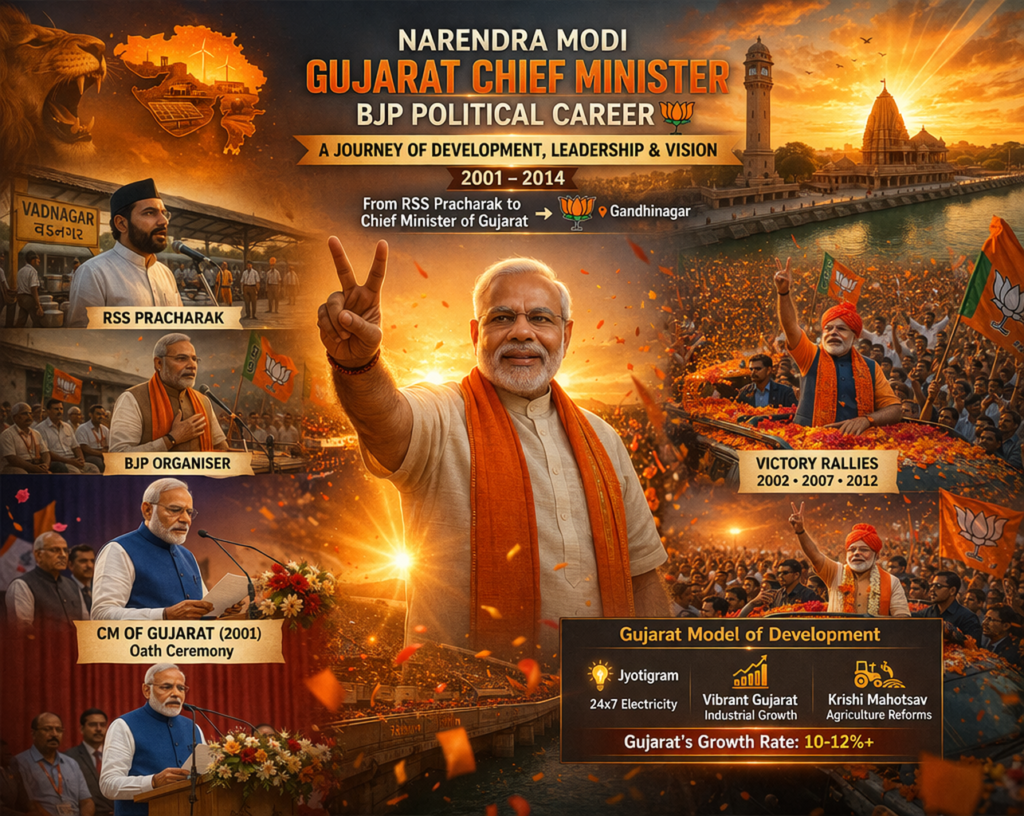
What started as a role quickly became a defining tenure for Narendra Modi. He won Gujarats state elections in 2002, 2007 and 2012 one, after the other. He became known as a leader who focused on governance. Narendra Modi prioritised infrastructure, industrial investment and efficient public administration. The “Gujarat Model” of development became his calling card. This model focused on roads, power supply, investor-friendly policies and bureaucratic accountability. As Narendra Modi positioned himself for a national role the Gujarat Model became what he was known for.
Rise to National Politics: The 2014 General Election
The year 2014 was the decisive turning point in Narendra Modi’s political career, when he was chosen as the prime ministerial candidate for the BJP in the general elections, and his campaign slogan — Achhe Din Aayenge (“Good days will come”) which was unprecedented in scale, scope, and reach, not only attracted the support of the people but also resulted in a historic victory for the BJP, as it secured 282 seats in the 543-member Lok Sabha, achieving an absolute majority for a single party after a gap of 30 years, with the BJP-led NDA bagging a total of 336 seats in the Lok Sabha.
Narendra Modi was sworn in as the Prime Minister of India on 26 May 2014, in a ceremony held at Rashtrapati Bhavan, which was attended by leaders from across South Asia, including Pakistan, a move that was interpreted as a sign of his commitment to regional diplomacy.
He again won in the year 2019 with an even higher mandate, with the BJP alone securing 303 seats. And in the year 2024, though the BJP-led alliance failed to secure an absolute majority, it secured 293 seats and formed the government with Modi securing a historic third term as the Prime Minister of the country, a feat that only one man in the history of India has achieved.
Narendra Modi as Prime Minister of India: Governance Style and Leadership
To really get Narendra Modi as the Prime Minister of India you need to understand how he leads and the system he has put in place. Narendra Modis way of doing things is about making decisions from the top creating an image using technology and social media to talk to people directly and focusing on big projects. Narendra Modi has a radio show called Mann Ki Baat where he talks to the country without going through the press. This is something and it lets him speak to people without anyone in between.
Narendra Modis leadership style is a mix of being popular with people and being good with technology. He talks to people in a way that they can understand which is really popular in small towns and villages. At the time he is very detail-oriented and wants his team to be responsible for what they do. When Narendra Modi meets with his team they make decisions quickly which is different from how things were done
Some people do not like that Narendra Modi makes most of the decisions himself. They think this means other parts of the government do not have much freedom to make their own choices. On the hand his supporters think this way of doing things allows for big changes to happen quickly. Whatever you think it is clear that Narendra Modi has changed the way the government, in India works. He has changed the way things are done and how people think about the government.
Narendra Modi Government Schemes: Key Policies and Programmes
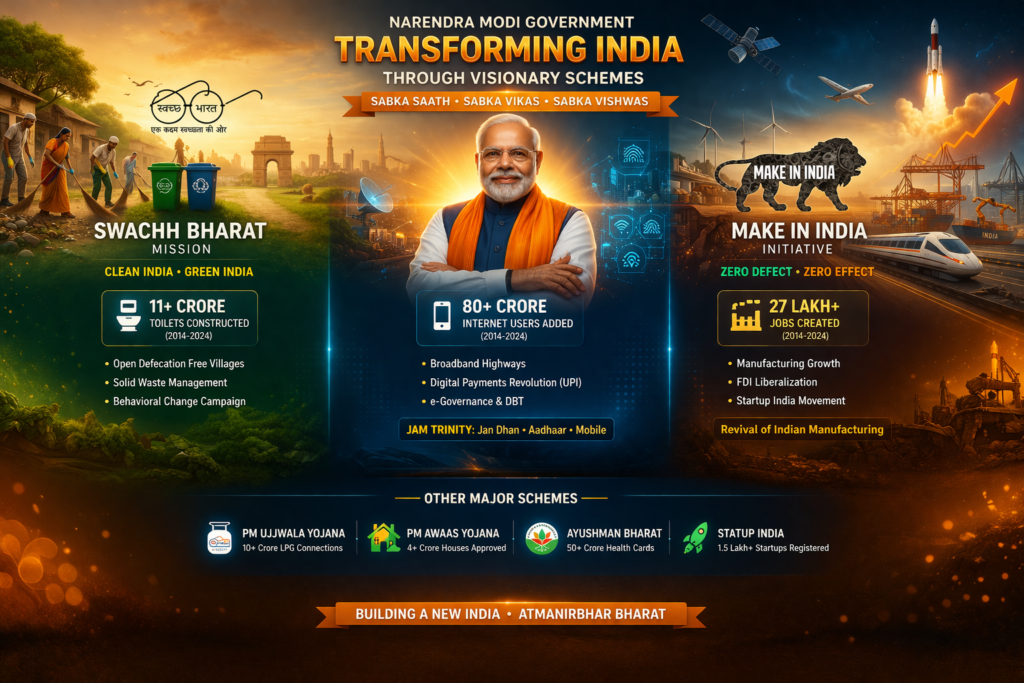
One of the features of Narendra Modis government plans is their size and goal. These programs show a plan to combine helping people with big changes to the countrys structure.
- Swachh Bharat Abhiyan or Clean India Mission started in October 2014. It aimed to stop people from defecating in areas across India and improve sanitation facilities. The program said it built over 100 million toilets in urban India by 2019. People have talked about whether the goals were met but theres no doubt that people now think differently about cleanliness and sanitation.
- The Digital India campaign started in 2015. It wanted to make India a country where people use technology to get information and do things. The campaign built internet infrastructure expanded mobile phone connections and made government services available online. This campaign has made a lot of progress. Today India is one of the worlds fastest-growing digital economies. It has over 900 million people using the internet and a growing fintech sector that uses the Unified Payments Interface.
- The Make in India initiative also started early in Modis term. It aimed to make India a global center for manufacturing. It encouraged foreign companies to manufacture in India. The policy was supported by making it easier for foreign companies to invest, simplifying rules and investing in industrial areas.
- In 2017 the government introduced the Goods and Services Tax (GST). This was the tax change in Indias history since it became independent. The GST replaced central and state taxes with one tax. It made it easier for businesses to follow tax rules and improved tax collection. However some medium-sized businesses had problems when it first started.
- The PM Awas Yojana housing scheme approved over 42 million homes between 2014 and 2024. This helped solve Indias standing problem of not having enough homes in urban and rural areas. The Jal Jeevan Mission started in 2019. It aims to provide piped drinking water to every household. This solves a problem in areas that had existed for generations.
- The governments decision to demonetize currency notes in November 2016 was very controversial. The government suddenly stopped using ₹500 and ₹1,000 notes. Supporters said it would reduce money and encourage people to use formal banking channels. Critics said it caused short-term problems for informal workers and small businesses. They said it had limited impact on the shadow economy.
The government changed the status of Jammu & Kashmir in 2019. It removed Article 370 of the Indian Constitution. Divided the state into two union territories. This was another controversial decision. Modi and his supporters said it integrated J&K into the constitutional framework. Critics raised concerns, about the process and regional autonomy.
Narendra Modi Achievements: A Summary
The Narendra Modi achievements across his tenures in office are many.
Here are some of them:
- Governance: India became the worlds fifth-largest economy during Modis tenure. It overtook the United Kingdom. The country also became one of the worlds growing major economies. This happened because of GDP growth rates. The growth happened before the COVID-19 disruption.
- Infrastructure: Indias highway construction rate increased a lot. Many metro rail networks were built in dozens of cities. The Vande Bharat Express trains were introduced. They represent a generation of semi-high-speed rail. Major expressways like the Delhi-Mumbai Expressway were built.
- policy: Modi did a lot of diplomacy. This elevated Indias international stature. He made relationships with the United States, Japan, Australia and the Gulf nations. He also kept ties with Russia. India hosted the G20 Summit in 2023 under his leadership. It was seen as a success. It showed Indias emerging role.
- International recognition: Modi received civilian honours from dozens of countries. He got Russias Order of St. Andrew. He also got Frances Grand Cross of the Legion of Honour. He received the United Arab Emirates Order of Zayed. Egypt gave him the Order of Nile. He got the Seoul Peace Prize. Many nations gave him the Grand Cross. He is the internationally decorated Indian leader in history.
- Yoga diplomacy: Modi proposed an International Day of Yoga. The United Nations adopted it in 2014. They designated 21 June as International Yoga Day. It was a soft power triumph. It brought cultural tradition to a global audience.
- Welfare delivery: The Pradhan Mantri Jan Dhan Yojana helped hundreds of millions of Indians. They were previously unbanked. The scheme brought them into the banking system. The Ujjwala Yojana gave free cooking gas connections to women. This reduced dependence, on firewood. It improved health outcomes.
Controversies and Criticism
A good Narendra Modi biography should talk about the things that have happened during his career. What happened when he was the Chief Minister of Gujarat during the 2002 riots is a deal. A lot of people died, over 1,000 and many people have criticized him for it. The courts have looked into it. Narendra Modi has not been found guilty.
Groups and human rights people are worried about the freedom of the press the rights of minorities and how the government treats people who disagree with them. India is not doing well in terms of press freedom and democracy. This has been getting worse while Narendra Modi is in charge. The decision to get rid of money is still something that people argue about and it affects the economy and politics.
These are all part of the things that people think about when they think about Narendra Modi. It is a story that is still changing as India becomes a more important country in the world. India and Narendra Modi are still figuring things out.
Narendra Modi’s Legacy and Third Term
Narendra Modis political journey is now in its act as Prime Minister. This journey shows both the hopes and problems of todays India. At 75 he is still one of the well-known politicians in the world. Many people around the world admire him and his approval ratings are very high.
His third term started in June 2024. He leads a group of parties, not one party. He is focusing on building infrastructure using technology and talking to other countries.. Some people are still arguing about how fair India is and how much freedom its citizens have.
People will talk about Narendra Modi for a time. Some will say he helped Indias infrastructure and made it important, in the world. Others will say that while he was Prime Minister, Indias institutional problems got worse. Indian voters, scholars and citizens will keep debating this for a time.
FAQ: Narendra Modi — Common Questions Answered
Q1: Who is Narendra Modi? Narendra Modi is the 14th and current Prime Minister of India, serving since 26 May 2014. He is a senior leader of the Bharatiya Janata Party (BJP) and previously served as the Chief Minister of Gujarat from 2001 to 2014.
Q2: What is Narendra Modi’s date of birth and age? Narendra Modi was born on 17 September 1950 in Vadnagar, Gujarat. As of his 2025 birthday, he is 75 years old.
Q3: What is Narendra Modi’s educational qualification? Modi holds a Bachelor’s degree in Political Science from the University of Delhi (School of Open Learning) and a Master of Arts degree in Political Science from Gujarat University, Ahmedabad.
Q4: Why is Narendra Modi famous? Narendra Modi is famous for leading the BJP to historic general election victories in 2014, 2019, and 2024; for launching landmark programmes like Swachh Bharat Abhiyan, Digital India, and Make in India; for his high-profile global diplomacy; and for being the first non-Congress leader to win three consecutive national elections.
Q5: What are Narendra Modi’s major achievements? His key achievements include infrastructure expansion (highways, metro, expressways), making India the world’s fifth-largest economy, launching GST reform, the Digital India and Make in India initiatives, welfare programmes like PM Awas Yojana and Jal Jeevan Mission, and earning India the G20 presidency in 2023.
Q6: What are Narendra Modi’s government schemes? Major Modi government schemes include Swachh Bharat Abhiyan, Digital India, Make in India, PM Awas Yojana, Jal Jeevan Mission, PM Kisan Samman Nidhi, Ujjwala Yojana, Ayushman Bharat (health insurance), and PM Jan Dhan Yojana.
Q7: How many terms has Narendra Modi served as Prime Minister? As of 2025, Narendra Modi has served three consecutive terms as Prime Minister: 2014–2019, 2019–2024, and from June 2024 onward.
Q8: What is the Gujarat Model associated with Modi? The “Gujarat Model” refers to the governance philosophy Modi implemented as Chief Minister of Gujarat, focused on investor-friendly policies, infrastructure development, reliable power supply, and efficient administration, which he later sought to scale nationally.
Conclusion
Narendra Modi is definitely one of the talked about and important politicians of the 21st century. His life story is not about how he became a politician. It’s also about how India, the worlds biggest democracy has changed over time with all its good and bad sides, hopes and energy.
If you are someone who studies politics does research writes for newspapers or just wants to know whats happening in India looking at Narendra Modis career, achievements and government plans that have changed many lives is really helpful.
📌 If you want to keep up with whats happening in politics and the policies of the Modi government. you should bookmark this page