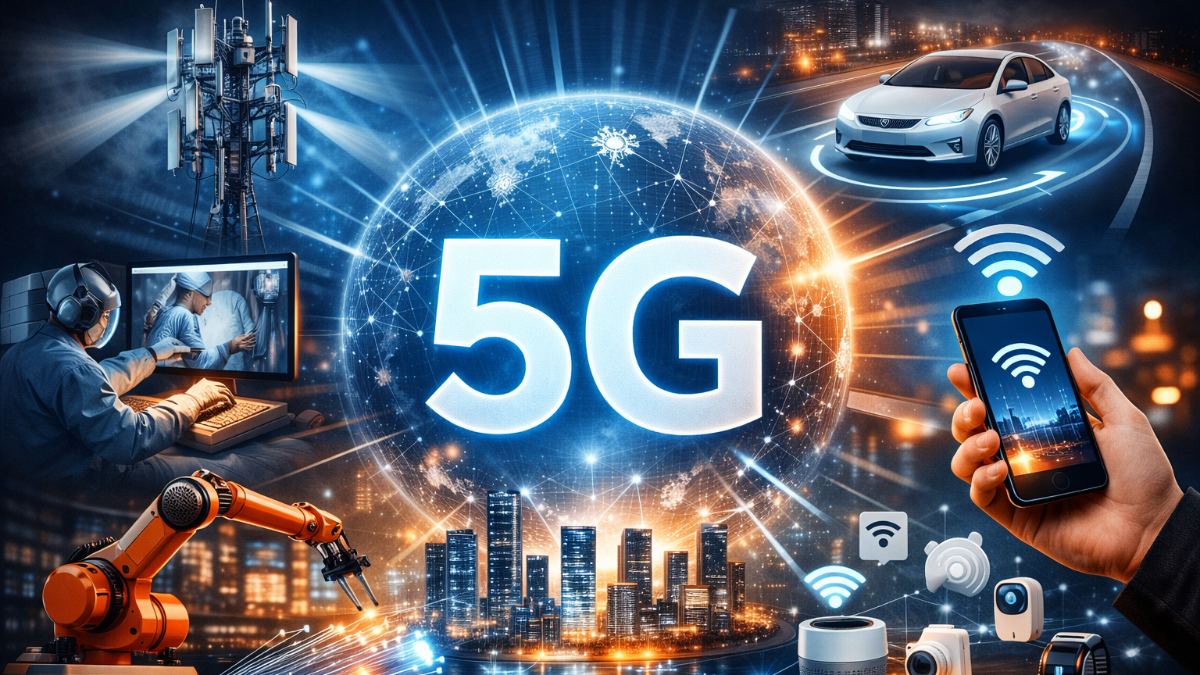
How 5G Technology Works
Understanding how 5G technology works is crucial to knowing what the future of wireless connectivity holds. 5G or fifth-generation mobile network technology, is the step in wireless network design. It offers data speeds, ultra-low latency and massive device connectivity. This is an improvement over earlier generations like 4G LTE.
The 5G network technology makes wireless signals work better between devices and network infrastructure. It uses antenna systems, new radio frequencies and smart network management. This enables faster communication and more reliable connections. With 5G technology innovations like cities, autonomous vehicles and remote healthcare can take off. The Internet of Things (IoT) will also benefit from 5G.
This guide 5G network explained, in detail. It covers how 5G network works the technologies used, real-world applications of 5G and what 5G can achieve in the future.
What Is 5G Technology
What is 5G technology? It is the generation of mobile communication systems that will replace and make 4G networks better. The main goal of 5G technology is to give us 5G internet speed, more space for devices and better connections for a lot of devices.
The advantages of 5G technology include:
- Faster downloads and uploads
- Less delay when we use the internet
- 5G technology makes the network more reliable
- A lot of devices can connect to 5G technology at the time
- Better internet on our phones
Compared with earlier systems, 5G connectivity can support more simultaneous connections while maintaining stable performance.
How 5G Technology Works
How 5G Technology Works
To understand how 5G technology works we need to look at how wireless communication happens.
- Step 1: Data Transmission
When you send data like watching a video or visiting a website your device sends the signal using radio waves.
- Step 2: 5G Base Stations
5G towers or base stations receive these signals. These towers have antenna systems that can handle many signals at the same time.
- Step 3: Network Routing
The data goes through fiber networks that are connected to the internet.
- Step 4: Signal Delivery
The data you asked for travels, through the network and is delivered to your device.
This is how 5G communication works. It shows how wireless signals move between devices and 5G network infrastructure.
Core Technologies Behind 5G
Several innovations make 5G network speed significantly faster than previous networks.
Millimeter Wave Technology
Millimeter wave 5G technology uses extremely high-frequency radio waves. These waves allow much larger amounts of data to be transmitted.
However, they have a shorter range, which is why networks require additional infrastructure.
Small Cell Technology
Small cell technology in 5G uses compact base stations placed close together in urban areas.
These small cells improve coverage and answer the question: why 5G needs small cell towers.
Benefits include:
- Improved signal strength
- Increased network capacity
- Reduced congestion
Massive MIMO
Massive MIMO is a term used in 5G. It means Multiple Input Multiple Output.
We use antennas at base stations to send and receive several data signals at the same time.
This really boosts network efficiency and data speed.
Beamforming
Beamforming in 5G networks helps send signals to specific devices. It does not send signals in every direction.
This tech makes connections better. It shows how beamforming makes 5G connections work well.
What Makes 5G Faster Than 4G
Many users wonder what makes 5G faster than 4G.
The answer lies in several factors:
- Wider radio spectrum bands
- Advanced antenna systems
- Higher frequency signals
- Optimized network architecture
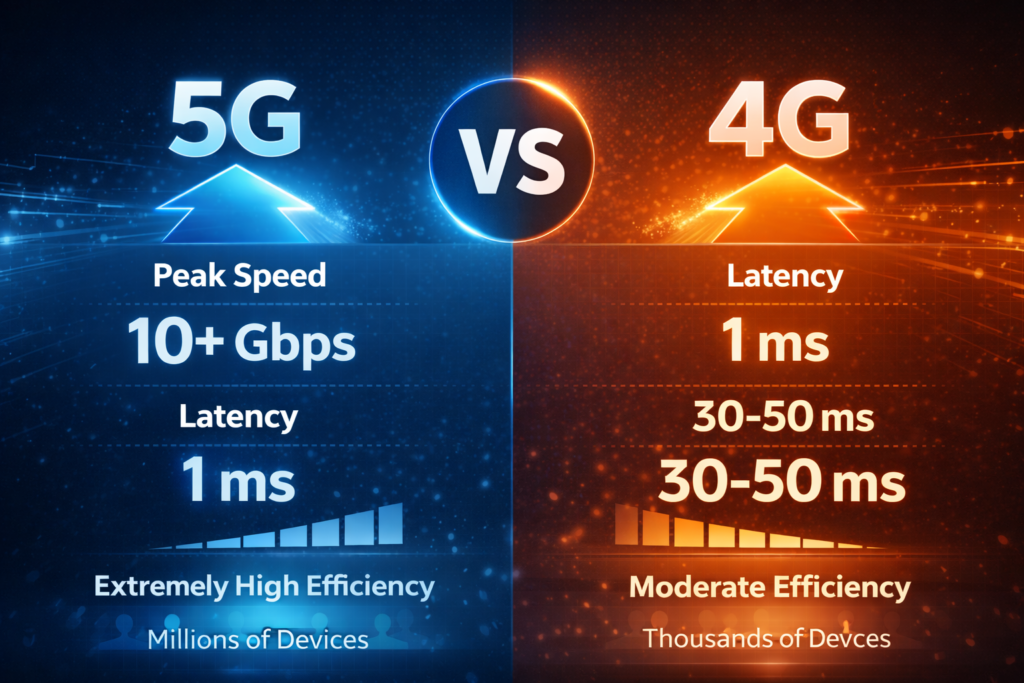
The 5G vs 4G technology difference includes:
| Feature | 4G | 5G |
|---|---|---|
| Peak Speed | 1 Gbps | 10+ Gbps |
| Latency | 30–50 ms | 1–10 ms |
| Device Capacity | Thousands | Millions |
| Network Efficiency | Moderate | Extremely High |
This improvement explains how 5G is different from 4G and why it is considered a revolutionary upgrade.
5G Network Architecture Explained
A typical 5G network architecture explained includes several components.
Radio Access Network (RAN)
Handles wireless communication between devices and towers.
Core Network
Manages authentication, routing, and data delivery.
Edge Computing
Processes data closer to the user to reduce latency.
This architecture improves how 5G data transmission works and supports faster services.
Types of 5G Networks
There are three primary types of 5G deployment.
Low-Band 5G
- Large coverage area
- Moderate speeds
Mid-Band 5G
- Balanced speed and coverage
High-Band (mmWave) 5G
- Extremely high speeds
- Limited range
Together these create the overall 5G connectivity ecosystem.
Real World Applications of 5G Technology
The 5G technology has a lot of world applications that are used in many different areas.
5G technology is really changing things. The real world applications of 5G technology are very important.
Smart Cities
5G technology helps make cities better by improving traffic systems and energy usage and urban planning. 5G technology makes cities smarter.
Healthcare
Doctors can now do things from away like check patients and even do surgery with robots. 5G technology is helping doctors to do their job better.
Autonomous Vehicles
Cars can now talk to traffic systems and other cars at the time. 5G technology is making autonomous vehicles safer.
Industrial Automation
Factories are using 5G technology to make things with precision by using robots and sensors. 5G technology is helping factories to work
Internet of Things
How 5G supports IoT devices is critical, enabling billions of sensors and smart devices to communicate efficiently.
5G vs WiFi and LTE
5G vs LTE Speed Comparison
5G provides much higher bandwidth and faster speeds than LTE networks.
5G vs WiFi Performance
| Technology | Coverage | Mobility | Speed |
|---|---|---|---|
| WiFi | Local | Limited | High |
| LTE | Wide | High | Moderate |
| 5G | Very Wide | High | Extremely High |
Benefits of 5G Technology
The 5G technology benefits extend to both consumers and industries.
Key advantages include:
- Ultra-fast downloads
- Seamless video streaming
- Improved gaming performance
- Smart city infrastructure
- Industrial automation
Businesses benefit from reliable networks capable of handling massive digital workloads.
Read Also- Artificial Intelligence: History, Types & Global Impact
Challenges Facing 5G Deployment
Despite the advantages there are challenges.
Infrastructure Cost
Deploying millions of cells costs a lot of money.
Coverage Issues
Signals, with frequency have trouble going through buildings.
Security Concerns
With connectivity there are more risks of cyber attacks.
Spectrum Availability
Governments need to give out radio frequencies in a way.
Future of 5G Technology
The future of next generation wireless network technology looks promising.
Upcoming developments include:
- 5G Advanced networks
- Integration with artificial intelligence
- Expanded edge computing
- Smart infrastructure
These innovations will further improve how 5G technology works and enable even more connected environments.
Frequently Asked Questions
What is the working principle of 5G?
The working principle of 5G relies on high-frequency radio waves, advanced antenna systems, and intelligent network architecture to transmit data faster and more efficiently.
How does 5G reduce latency?
How 5G reduces latency in mobile networks involves edge computing, optimized routing, and faster signal processing.
Why is 5G important?
5G enables faster internet, improved connectivity, and the development of emerging technologies like smart cities and autonomous transportation.
How fast is 5G internet speed?
Typical 5G internet speed ranges between 1 Gbps and 10 Gbps depending on network conditions.
Call to Action
The world is changing with 5G technology. It is affecting lots of industries. 5G technology is very important. To get ready for the future people and companies need to know how 5G technology works. This will help them understand what 5G technology can do.
If you want to learn about 5G technology and other things like that you should follow our updates. We talk, about 5G technology and other new tech stuff. This way you can stay ahead. Know what is happening in the world of 5G technology and other digital things.