Artificial Intelligence
Artificial Intelligence (AI) is the capability of machines and computer systems to execute tasks that require human intelligence. These tasks include tasks such as reasoning, learning, problem-solving, perception, and understanding language. Instead of following a set of instructions, Artificial Intelligence systems analyze data, identify patterns, and learn from experiences.
Over the past decades, Artificial Intelligence has transitioned from being a theoretical concept to being a reality. It is used in search engines, virtual assistants, recommendation systems, medical diagnosis, and self-driving cars. As the power of computers and the availability of data have grown, Machine Learning and other AI technologies have made rapid progress.
Artificial Intelligence is currently one of the most impactful technologies of the 21st century.
Definition and Key Concepts
In essence, Artificial Intelligence is a field of computer science that focuses on developing systems that can mimic human cognitive abilities. These abilities include:
- Learning from data
- Arriving at logical conclusions
- Understanding language
- Perceiving images and sounds
- Making well-informed decisions
The majority of current Artificial Intelligence systems are based on Machine Learning algorithms, which enable computers to learn from data rather than following a set of predefined rules.
There are three types of AI systems:
Narrow AI (Weak AI)
These are designed to perform a particular task, such as spam detection or facial recognition. The vast majority of current AI systems fall into this category.
General AI (Strong AI)
This is a theoretical concept of Artificial Intelligence that has the potential to solve any intellectual problem that a human can solve. It is still a research area.
Superintelligent AI
This is a hypothetical level of Artificial Intelligence that exceeds human intelligence in all areas.
Historical Development
Early Foundations
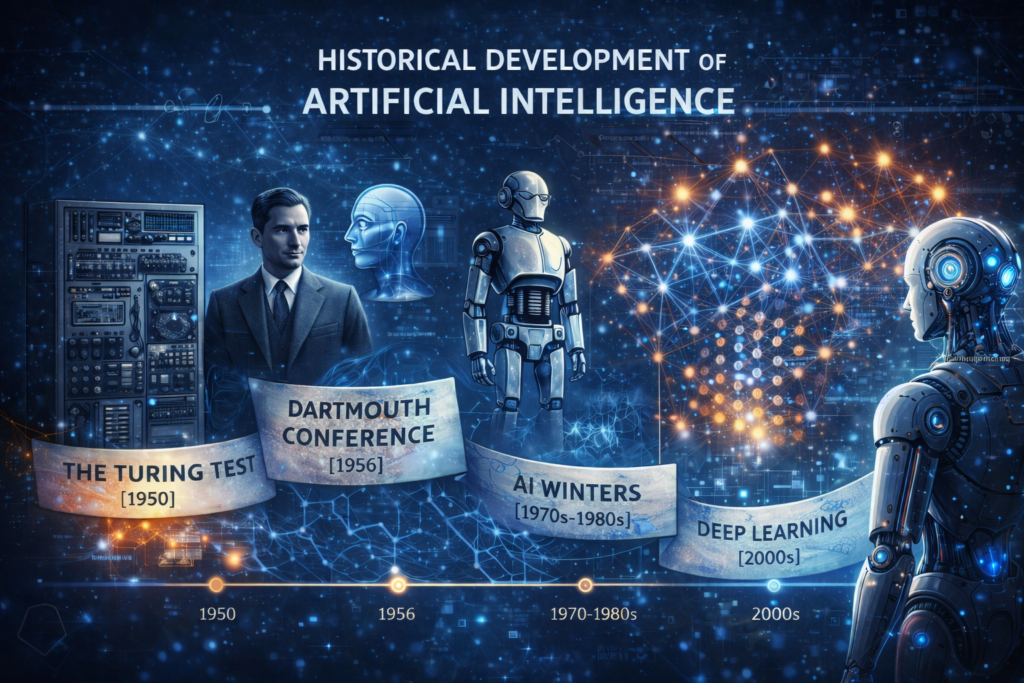
The conceptual foundations of Artificial Intelligence lie in the early theories of computing. In 1950, Alan Turing proposed the concept of assessing machine intelligence using what came to be called the Turing Test [Source: Computing Machinery and Intelligence, 1950].
Dartmouth Conference (1956)
The term Artificial Intelligence was coined at the Dartmouth Conference in 1956 [Source: Dartmouth Conference Report, 1956]. Scientists were optimistic that intelligent machines could be developed in a generation, although this turned out to be more challenging than expected.
AI Winters and Revival
There were periods of lower investment and few major advances, or “AI winters,” in the 1970s and 1980s. However, the advent of Deep Learning technology, more data, and more processing power brought a resurgence in the 2000s.
The 2010s saw major advances in image and language understanding, and Artificial Intelligence applications improved significantly [Source: Stanford AI Index Report, 2023].
Key Technologies Behind Artificial Intelligence
Machine Learning
Machine Learning is a branch of Artificial Intelligence that helps machines learn from data automatically. Some popular techniques used in Machine Learning are:
- Supervised learning
- Unsupervised learning
- Reinforcement learning
These techniques help AI systems increase their accuracy over time.
Deep Learning
Deep Learning technology employs multi-layered neural networks to analyze complex data such as images, speech, and text. Deep Learning has greatly improved speech recognition systems, translation software, and generative AI tools.
Natural Language Processing (NLP)
NLP helps Artificial Intelligence systems understand and produce human language. Chatbots, translation software, and virtual assistants are developed using NLP libraries.
Computer Vision
Computer vision helps AI systems analyze visual data. Computer vision applications include medical image analysis and self-driving cars.
Applications Across Industries
AI in Healthcare
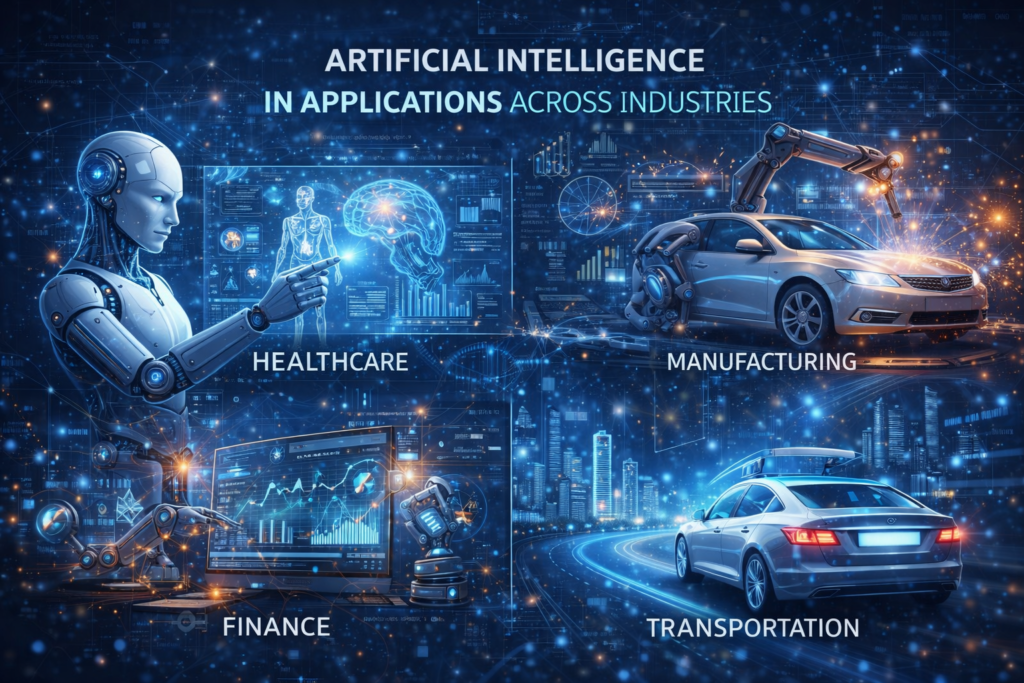
AI in the healthcare industry helps with disease diagnosis, predictive analysis, and the development of medications. Machine learning algorithms help with the analysis of images and patient information to enable doctors to make diagnoses faster and more accurately [Source: World Health Organization Report, 2022].
Finance and Banking
Banks apply Artificial Intelligence tools to detect fraud, make credit decisions, and execute trades automatically. Artificial Intelligence systems can process large amounts of financial information in real-time.
Transportation
Autonomous cars apply Artificial Intelligence to process sensor information and drive on the roads safely.
Education
Artificial Intelligence tools in education enable the creation of personalized learning experiences for students based on their performance and engagement levels.
Business and Marketing
Personalized product recommendations, online advertising, and customer service chatbots are examples of the impact of Artificial Intelligence on various sectors across the globe.
Economic and Social Impact
Economic Growth
Economic studies have shown that Artificial Intelligence could contribute trillions of dollars to the global GDP by improving productivity and innovation [Source: McKinsey Global Institute Report, 2023].
Workforce Transformation
While automation through AI could replace some routine jobs, it could also generate new jobs in the fields of data science, AI engineering, and system management.
Ethical and Governance Issues
The fast-paced development of Artificial Intelligence has brought about concerns in the following areas:
- Data privacy
- Bias in algorithms
- Transparency
- Accountability
Governments and institutions are increasingly working on frameworks for responsible AI use.
Future Scope of Artificial Intelligence
The future scope of Artificial Intelligence technology involve the study of explainable AI, better human-AI collaboration, and highly advanced reasoning systems. Although general AI is still in the theoretical stage, continuous enhancements in Machine Learning algorithms indicate an ongoing increase in capabilities.
Ai future trends of emerging AI involve sustainability, healthcare innovation, cybersecurity, and intelligent automation systems. The future of Artificial Intelligence will probably be driven by ethical governance, technological advancements, and societal evolution.